Launching a warranty program once meant navigating a web of regulatory red tape, slow-moving IT systems, and inflexible insurance partners. But in 2025, OEMs, retailers, and DTC brands have a new playbook: white-label, API-first, compliance-aligned warranty platforms that launch in as little as 30 days.
This guide explores how brands across North America are modernizing their warranty programs for speed, compliance, and revenue—with expert insight from All Shield’s proprietary data.
For those evaluating options, see our comparison of white-label vs. co-branded warranty models.
The Big Shift: Why Warranties Are No Longer Optional
Three major trends have converged:
- Regulatory enforcement is tightening: FTC, FSRA, and Quebec’s Bill 64 require precise language, bilingual disclosures, and audit trails.
- Consumer expectations are rising: Millennials and Gen Z view warranty coverage as part of brand trust. Over 40% say it influences their buying decision.
- Profitability is under pressure: Brands need new post-sale revenue streams, and product protection plans can lift customer lifetime value (LTV) by 26–40%.
A warranty is no longer just a service contract—it’s a conversion asset.
“Warranties, when offered correctly, improve NPS, reduce return rates, and increase margin—all without adding operational friction.” — All Shield Strategy Council
To see how brands are executing these strategies, check our real-world warranty case studies.
Why Most Brands Fail at Warranty Programs (And How Not to)
Legacy approaches are built around insurers, not brands. Common issues include:
- Co-branded coverage that weakens brand equity
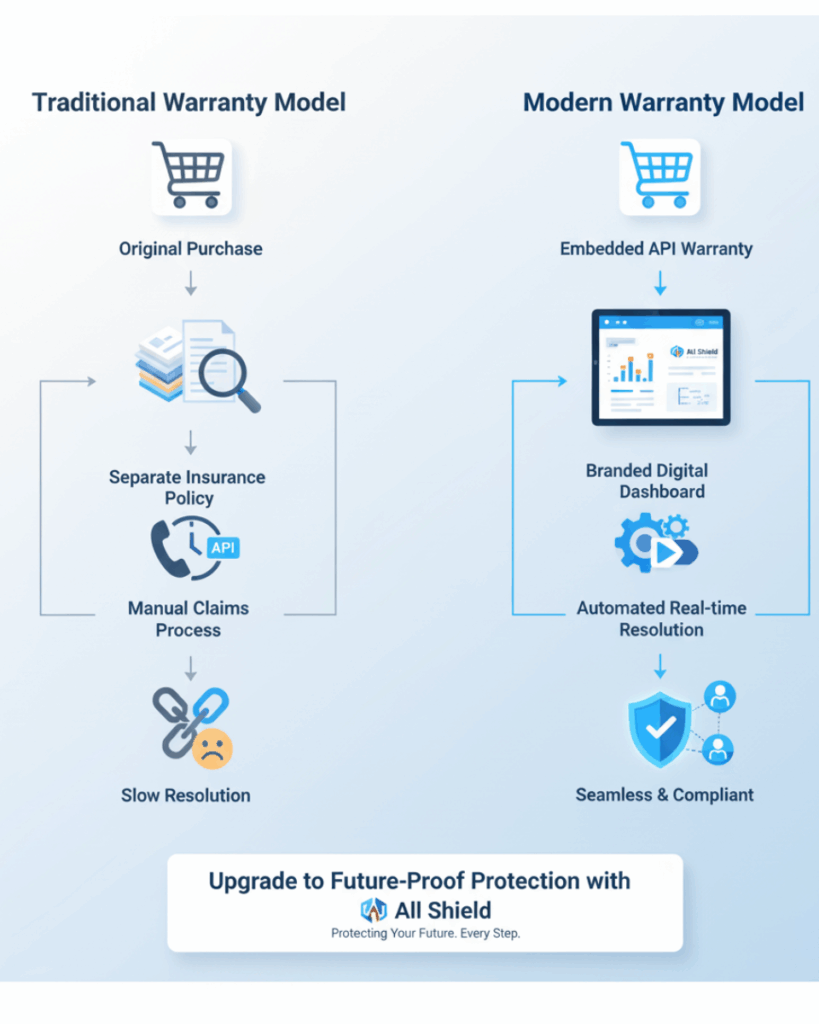
- Manual claims management that causes delays and customer frustration
- Lack of localization—especially critical in Quebec, where Bill 64 mandates French-language disclosure and consumer data governance
- Static platforms with no API, no automation, and no analytics
Modern programs flip this model: the brand retains control, and the platform handles compliance and delivery.
Learn how All Shield resolves these issues in our API-first integration.
What Does ‘Easy’ Actually Mean in 2025?
Today, launching a program should not require an in-house legal team or six-month IT roadmap. It should mean:
- API and plugin-based deployment across your CRM, POS, or eComm system
- White-label flexibility to match your brand tone and UX
- Audit-ready dashboards for compliance logs and claims history
- Automated communication flows (email/SMS) for claims, renewals, and customer support
Visual Suggestion: Flowchart comparing old vs. modern embedded warranty workflows
To understand how this fits into your tech ecosystem, view our platform integration capabilities.
Step 1: Own the Warranty Experience — Or Someone Else Will
Here’s a strategic comparison of coverage delivery models:
| Model | Brand Visibility | Setup Speed | Regulatory Control | Revenue Share |
|---|---|---|---|---|
| Insurance-backed | Low | 60–90 days | Limited | Low |
| Co-branded TPA | Moderate | 30–60 days | Partial | Medium |
| White-label SaaS (All Shield) | High | 14–30 days | Full | High |
Ownership matters. Customers trust your warranty terms, your brand, and your communication.
If you’re unsure about platform options, explore our modular solution framework.
Step 2: Integration Without IT Drama
All Shield offers plug-and-play or API-based integrations with:
- eCommerce platforms (Shopify, BigCommerce, WooCommerce)
- CRMs (Salesforce, HubSpot)
- ERPs (NetSuite, Oracle)
- POS systems (Square, Lightspeed)
All systems are compliant with FTC service contract guidance, FSRA expectations in Ontario, and Quebec’s Bill 64.
Download our All Shield API documentation to see how integration fits your stack.
Step 3: Build the Offer — Good, Better, Best Tiers
Protection should feel personal and optional—not predatory. Brands typically configure:
- Tiered coverage: basic, standard, premium
- Term durations: 1, 2, or 3 years
- Covered components: mechanical, electrical, accidental, or add-ons
- Pricing models: bundled, add-on, or upsell during checkout
“People don’t buy insurance. They buy peace of mind. That’s what you’re really selling.” — Inspired by Ogilvy principles
Curious about outcomes? Jump to our appliance and Quebec case studies below.
Step 4: Automate Claims, Renewals, and Compliance
Warranty program success depends on operational ease. With All Shield, brands access:
- Real-time claim adjudication
- Automated email/SMS renewal flows
- Compliance flags for all jurisdictions
- Downloadable audit logs and customer comms
- Bilingual workflows and disclosures (essential for Quebec markets)
This enables brands to deliver high-trust experiences and meet regulatory scrutiny.
For an overview of how we meet FTC, FSRA, and Bill 64 standards, review our regulatory compliance table.
Case Study #1: U.S. Appliance Brand Adds $1.2M in Revenue
A mid-market U.S. appliance company used All Shield to embed a warranty plugin in Shopify:
- Launched in 21 days
- Used a Good/Better/Best offer model
- Triggered post-sale email flows for protection offers
Results:
- 3x higher post-purchase attach rate
- $1.2M in new revenue
- 24% increase in return visit intent
See how we handled integration and automation.
Case Study #2: Quebec Dealer Gains Legal Peace of Mind
A regional auto and appliance dealer in Quebec faced challenges with bilingual service contracts and Bill 64 compliance.
Solution:
- Deployed All Shield’s dual-language platform
- Used pre-built compliance templates
- Enabled automatic audit log generation
Results:
- Passed FSRA and Quebec privacy checks
- 37% increase in service visits
- 12% boost in warranty conversions
Compare regional compliance across North America.
Product Protection as a Loyalty Engine
Warranties are retention assets. Done right, they:
- Increase Net Promoter Scores
- Provide upsell opportunities at renewal points
- Reduce returns and support tickets
They also reinforce customer belief that you stand by your product.
To explore how to monetize this loyalty, check our pricing psychology and tiering guide.
FAQ: What Brands Are Asking
-
Do I need an insurance license?
- No. All Shield uses service contract frameworks that comply with regional regulations, without requiring the brand to become an insurer.
-
What if I operate in Quebec?
- All Shield is aligned with Bill 64. Our system auto-generates French-language disclosures and privacy protocols.
-
Is All Shield available in the U.S. and Canada?
- Yes. It supports region-specific requirements including FTC (U.S.), FSRA (Ontario), and PIPEDA/Bill 64 (Canada).
-
How long does it take to launch?
- Average time is 14–30 days, depending on integration level.
-
What’s the ROI?
- Our data shows 26–40% LTV increase and 2–3× post-sale conversions.