
Lorem ipsum dolor sit amet, consectetur adipiscing elit. Ut elit tellus, luctus nec ullamcorper mattis, pulvinar dapibus leo.
Introduction: Why Consent Can’t Be an Afterthought
Customers today are increasingly skeptical of hidden terms, fine-print disclosures, and complicated warranty sign-ups. At the same time, regulators in both the United States and Canada are tightening rules on transparency and consent.
For OEMs, retailers, and auto dealers, consent can no longer be treated as a compliance checkbox. Instead, a consent-first warranty journey signals trust, improves adoption, and reduces regulatory risk. Done well, it also creates a competitive advantage in industries where customer confidence is the currency of growth.
This article explores how to design consent-first warranty experiences that combine legal compliance, UX best practices, and bilingual accessibility — with practical strategies for scaling across U.S. and Canadian markets.
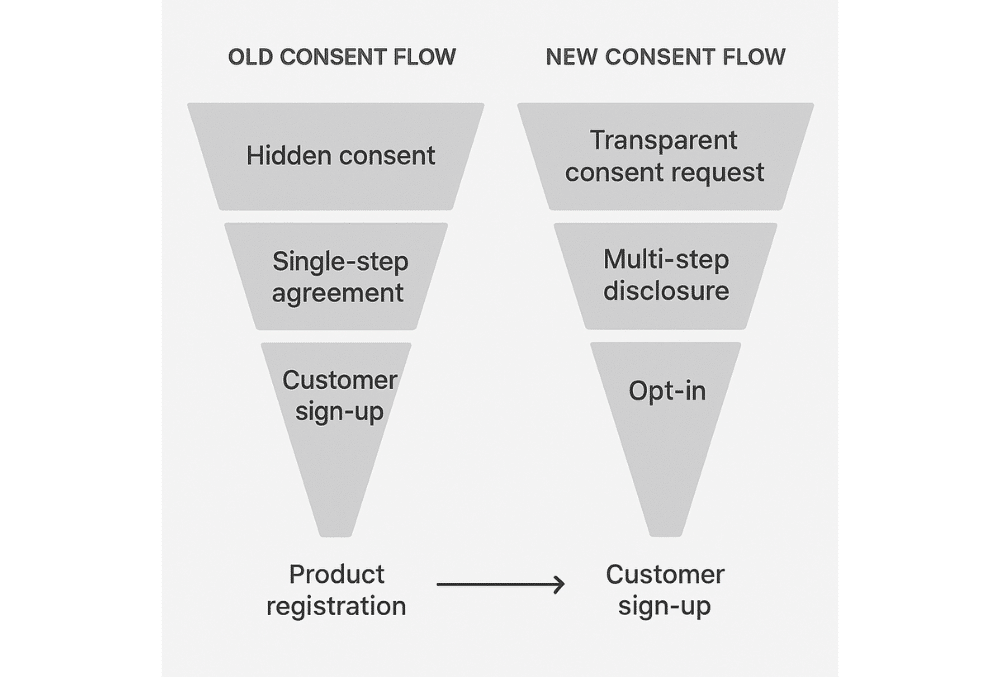
1. What is a Consent-First Warranty Journey?
A consent-first warranty journey is a customer experience framework that prioritizes clarity and choice. Rather than burying terms in small print, it ensures that customers understand and agree to warranty coverage at every step.
Key elements include:
Transparency – Clear disclosures at the point of sign-up.
Accessibility – Plain-language summaries instead of dense legal text.
Trackability – Digital audit logs of when, where, and how consent was given.
Traditional Flow: A single, pre-checked box hidden at the bottom of a long contract.
Modern Flow: Multi-step screens with plain-language summaries, bilingual parity, and digital receipts confirming consent.
Related: Warranty API Integration Solutions
2. Why Consent Design is a UX Challenge
When consent is poorly designed, companies face serious consequences:
Customer drop-offs during registration.
Regulatory risk from non-compliant disclosures.
Low trust and higher dispute rates.
UX research shows that transparent consent flows reduce churn by 23% (Forrester, 2021). The best consent-first designs apply proven UX practices:
Break legal content into digestible steps.
Use expandable FAQs instead of overwhelming walls of text.
Send email/SMS receipts confirming what the customer agreed to.
These practices not only reduce compliance risks but also increase customer satisfaction — because clarity builds confidence.
Related: The Retailer’s Guide to Monetizing Post-Sale Support
3. The Bilingual Imperative in Canada
In Canada, PIPEDA (federal law) and Quebec’s Bill 64 (Law 25) make bilingual consent a legal requirement. Warranties and service contracts must be equally clear in both English and French.
But compliance isn’t just about translation — it’s about cultural parity. Quebec customers expect:
Equal clarity in French-language consent screens.
Plain-language French summaries, not machine-translated jargon.
UX parity across English and French interfaces.
Failure to comply can result in steep penalties, reputational damage, and customer churn.
Related: Quebec Bill 64 Warranty Services: Are You Compliant?
1. What is a Consent-First Warranty Journey?
A consent-first warranty journey is a customer experience framework that prioritizes clarity and choice. Rather than burying terms in small print, it ensures that customers understand and agree to warranty coverage at every step.
Key elements include:
Transparency – Clear disclosures at the point of sign-up.
Accessibility – Plain-language summaries instead of dense legal text.
Trackability – Digital audit logs of when, where, and how consent was given.
Traditional Flow: A single, pre-checked box hidden at the bottom of a long contract.
Modern Flow: Multi-step screens with plain-language summaries, bilingual parity, and digital receipts confirming consent.
Related: Warranty API Integration Solutions
2. Why Consent Design is a UX Challenge
When consent is poorly designed, companies face serious consequences:
Customer drop-offs during registration.
Regulatory risk from non-compliant disclosures.
Low trust and higher dispute rates.
UX research shows that transparent consent flows reduce churn by 23% (Forrester, 2021). The best consent-first designs apply proven UX practices:
Break legal content into digestible steps.
Use expandable FAQs instead of overwhelming walls of text.
Send email/SMS receipts confirming what the customer agreed to.
These practices not only reduce compliance risks but also increase customer satisfaction — because clarity builds confidence.
Related: The Retailer’s Guide to Monetizing Post-Sale Support
3. The Bilingual Imperative in Canada
In Canada, PIPEDA (federal law) and Quebec’s Bill 64 (Law 25) make bilingual consent a legal requirement. Warranties and service contracts must be equally clear in both English and French.
But compliance isn’t just about translation — it’s about cultural parity. Quebec customers expect:
Equal clarity in French-language consent screens.
Plain-language French summaries, not machine-translated jargon.
UX parity across English and French interfaces.
Failure to comply can result in steep penalties, reputational damage, and customer churn.
Related: Quebec Bill 64 Warranty Services: Are You Compliant?
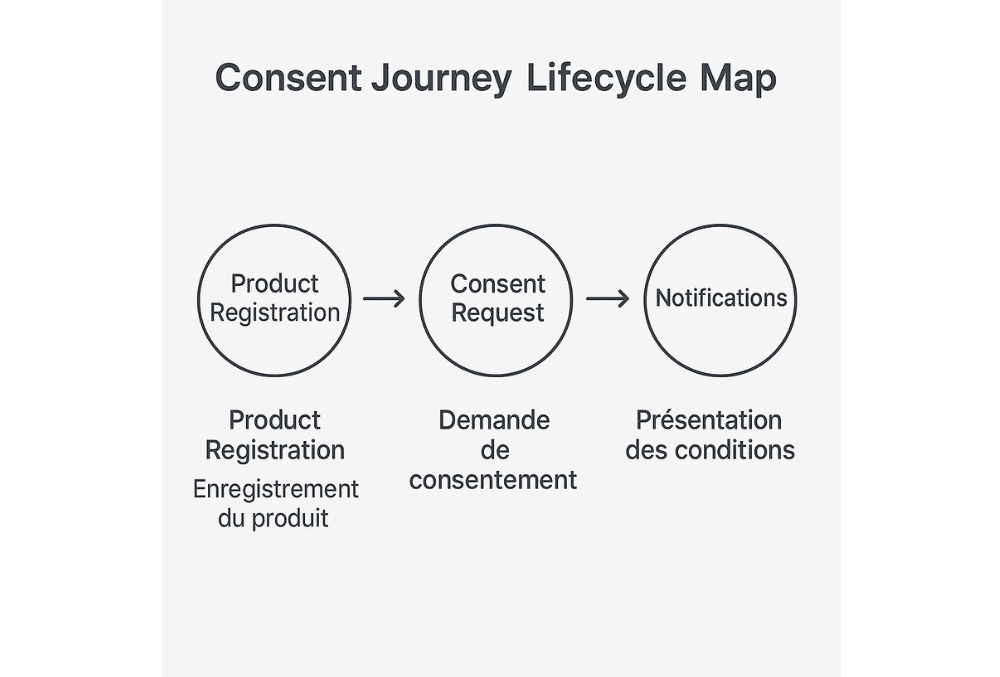
4. Mapping the Consent Journey Lifecycle
A consent-first journey integrates transparency at every customer touchpoint:
Product registration → Terms are displayed clearly in the customer’s chosen language.
Consent request → Customers opt in/out with digital logs stored for compliance.
Ongoing notifications → Renewal reminders and status updates sent via email/SMS.
Claims stage → Consent is reconfirmed before processing service requests.
Renewals → Customers have the ability to manage, renew, or revoke consent.
This lifecycle approach ensures that consent is ongoing, not a one-time checkbox.
5. UX & Design Principles for Consent Flows
Building effective consent-first experiences requires a commitment to ethical UX design. Core principles include:
No dark patterns – No pre-checked boxes or deceptive wording.
Mobile-first design – Consent flows must be easy to navigate on smartphones.
Accessibility compliance – Follow WCAG 2.1 and ADA standards for readability, contrast, and screen reader compatibility.
Microcopy – Use friendly, plain-language prompts (e.g., “By clicking agree, you accept the warranty coverage terms.”).
Related: Cybersecurity in Warranty Programs
6. Compliance as a Differentiator
Consent-first design is not just about avoiding penalties — it can be a trust-building differentiator.
U.S. Regulations
The FTC Warranty Rules require clear and conspicuous disclosure of service contract terms.
FTC Enforcement actions show growing scrutiny of misleading warranty practices.
Canada Regulations
PIPEDA requires lawful consent and secure handling of personal information.
Bill 64 (Law 25) mandates explicit, bilingual consent, breach notifications, and detailed audit logs.
Fines can reach $25M CAD or 4% of global revenue under Law 25 (CAI, Quebec).
- Official FTC Warranty Rules
- Office of the Privacy Commissioner of Canada
- Commission d’accès à l’information du Québec
7. Business Impact of Consent-First Journeys
Companies that prioritize consent-first workflows report measurable business benefits:
Higher opt-in rates – Customers are more likely to register when terms are clear.
Reduced disputes – Transparency eliminates “I didn’t agree to that” claims.
Customer loyalty – Trust-driven design fosters long-term brand relationships.
Post-sale revenue – Transparent warranties encourage renewals and add-ons.
Forrester’s 2021 research found that trust-centric experiences lower churn by nearly one-quarter, proving that compliance pays dividends.
8. Implementing Consent at Scale with APIs
Modern warranty providers are turning to API-driven consent management to automate compliance.
Registration APIs – Capture customer consent with timestamps at sign-up.
CRM/ERP integrations – Sync consent data across warranty and sales systems.
Audit logs – Exportable records for regulators on demand.
This API-first approach allows organizations to scale compliance, minimize human error, and prove governance readiness during audits.
Related: From Compliance to Conversion: Why OEMs Need API-Ready Warranties
9. The Future of Consent-First Warranty Design
Consent-first design is evolving beyond legal compliance to become a brand trust signal. Emerging trends include:
AI-driven personalization – Dynamic consent screens tailored by region, language, or product type.
Customer dashboards – Giving customers control to review, revoke, or renew consent in real-time.
Global frameworks – Expanding compliance alignment with GDPR (Europe) and CCPA (California) alongside PIPEDA and Bill 64.
Forward-looking brands will treat consent not as a cost, but as a trust asset.
Conclusion: Make Consent Your Competitive Edge
Consent-first warranty journeys build customer confidence, reduce regulatory risk, and create long-term loyalty. By aligning UX, bilingual accessibility, and compliance automation, organizations can transform legal obligations into business advantages.
- With All Shield, you can deliver consent-first experiences that meet global standards and delight customers.
- Book Your Compliance-Ready Warranty Demo Today
References
FAQs
1. What does consent-first mean in warranties?
It means placing customer understanding and agreement at the center of the warranty journey, rather than hiding terms in the fine print.
2. Why are bilingual consent flows important in Canada?
Because Quebec’s Bill 64 (Law 25) and PIPEDA require warranties to be disclosed clearly in both English and French.
3. Can consent be automated through APIs?
Yes. APIs can record, timestamp, and sync consent data across CRMs, ERPs, and warranty systems.
4. What regulations affect warranty consent?
The FTC Warranty Rules in the U.S., PIPEDA and Bill 64 in Canada, and global frameworks like GDPR and CCPA.
5. How does consent-first design improve customer trust?
By making terms transparent, accessible, and customer-friendly — increasing opt-in rates, reducing disputes, and boosting loyalty.