Executive Summary
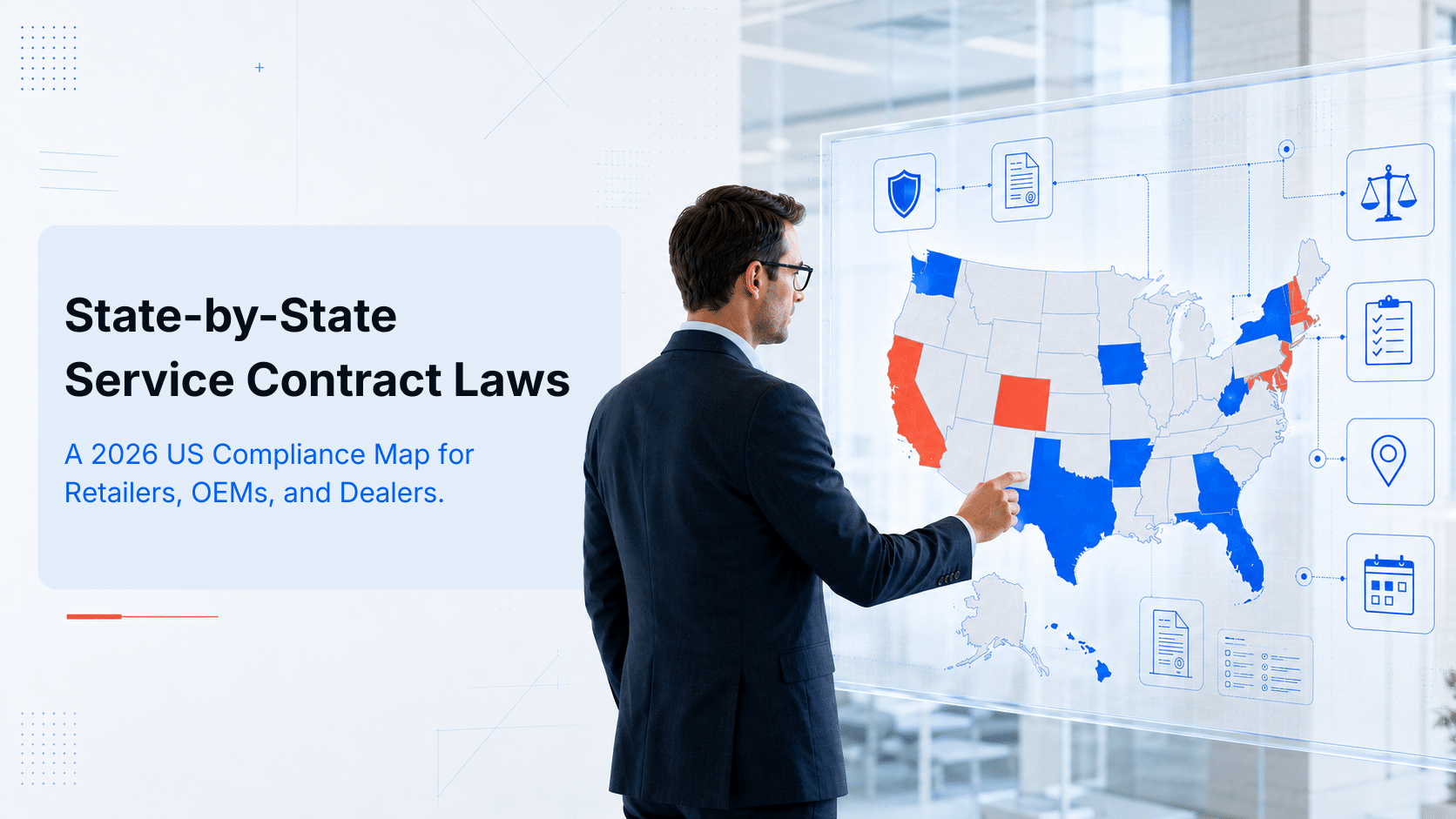
The United States has no single federal license for offering a service contract. Each state writes its own statute, picks its own regulator, and sets its own financial-security rule.
The NAIC Service Contracts Model Act (Model 685) is the backbone most states copy, but adoption varies and several states sit outside the insurance regime entirely.
Three federal pieces shape the field: Magnuson-Moss (15 USC Ch. 50), 16 CFR Part 700, and the McCarran-Ferguson Act that lets state insurance law usually win.
Recent enforcement to price in: the FTC’s USD 10 million CarShield settlement (July 2024), USD 9.6 million refunds distributed December 2025, Maryland HB 1046 (effective October 1, 2025), Fifth Circuit vacatur of the FTC CARS Rule (January 2025), and New Hampshire’s January 1, 2025 move to SERFF filings.
Three structural choices drive almost every multi-state program: who is the obligor, which financial-security method backs the obligation, and how each state’s filing and disclosure language gets satisfied.
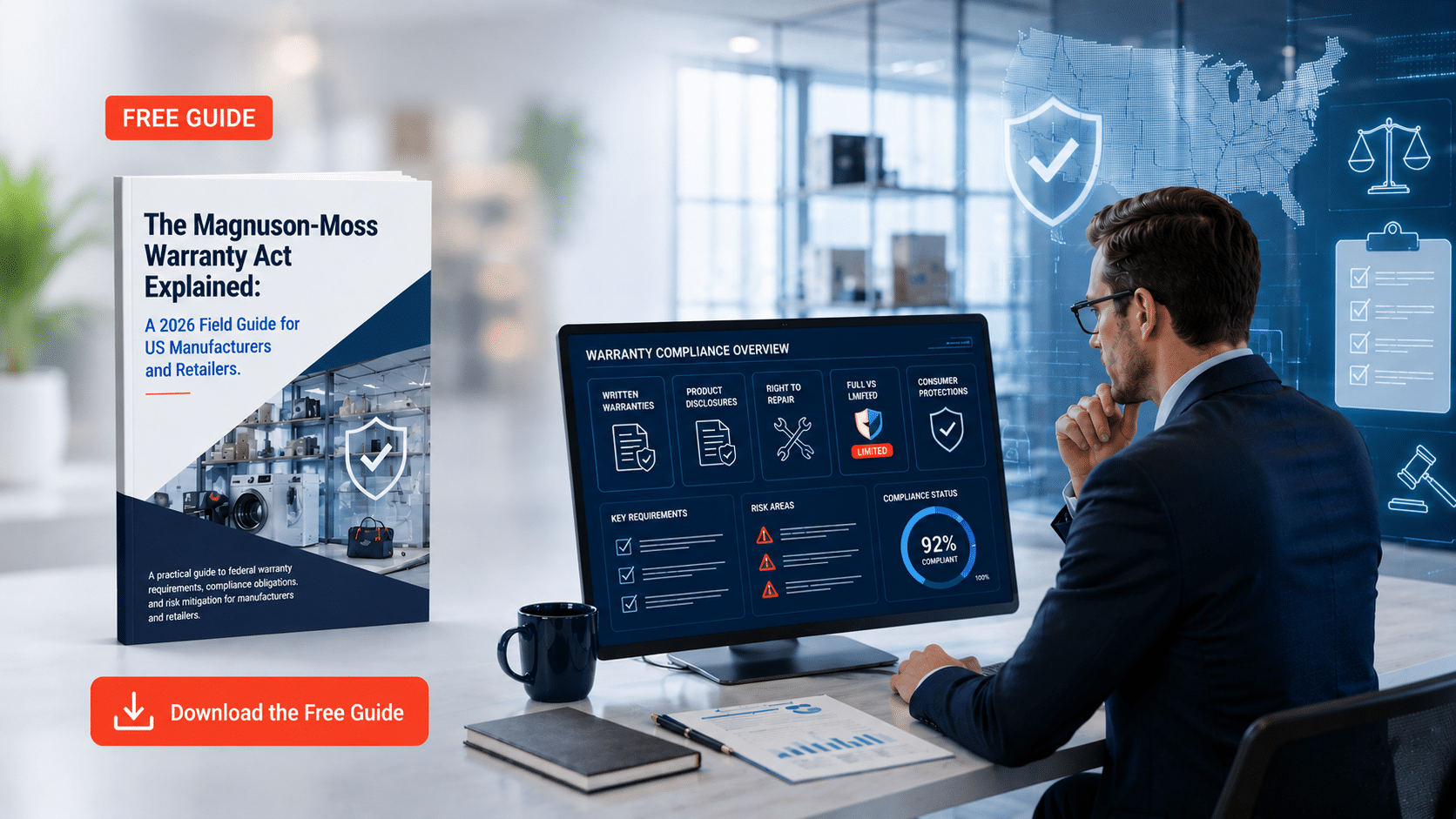
Download the 2026 State Compliance Matrix (PDF)
The 2026 State Compliance Matrix condenses the key licensing, regulator, filing, financial-security, and compliance requirements for all 50 states into a single reference guide. Download the matrix to quickly compare state requirements and support your multi-state service contract program.
In July 2024 the FTC settled with CarShield (NRRM, LLC) and American Auto Shield, LLC for USD 10 million over deceptive vehicle service contract advertising.1 Eighteen months later the FTC sent out 168,179 refund checks totaling more than USD 9.6 million.2 That order was federal. State-level enforcement, financial-security violations, and consumer complaints typically cost obligors more in aggregate every year than any single federal action.
A multi-rooftop auto dealer principal asked us in March 2026 why his flagship store hit 84% F&I VSC penetration while his next location ran 30% on the same product. The story behind the gap, once we got into it, was not a sales-floor issue. It was a compliance issue. Two of his stores were obligor-of-record. One was not. The product they sold was technically different in each state, and the menu language in two stores did not match the state’s required disclosure.
If you sell a single SKU nationwide, you are quietly running 50 separate compliance programs. Most operators do not see this until a state insurance department, a state licensing agency, or the FTC sees it for them. This map is the fix.
Who this report is for
This report is written for the businesses and leaders responsible for selling, launching, administering, or expanding service contract and extended warranty programs across multiple states.
That includes:
- Auto dealers and dealer groups selling vehicle service contracts, extended warranties, and F&I protection products across multiple rooftops.
- Manufacturers and OEMs offering product warranties, extended warranties, or protection programs after the initial product sale.
- Warranty providers and administrators responsible for building, backing, filing, or managing multi-state service contract programs.
- Retailers and ecommerce brands adding product protection or checkout-based coverage in states where they have not previously registered.
- Compliance, legal, F&I, product, and operations leaders who need to understand where licensing, obligor status, disclosures, filings, and financial-security requirements change by state.
The common thread is not company size. It is whether the business is selling or supporting a warranty, VSC, extended warranty, or protection product in more than one state.
Why service contract laws by state is a 50-puzzle, not a 50-checklist
The U.S. extended warranty market sat at USD 53.01 billion in 2025 and tracks to USD 117.02 billion by 2034.3 Globally, the category is USD 159.38 billion in 2025 and projects to USD 240.78 billion by 2030.4 Automotive captured 34.1% of the 2024 market share, and standard protection plans — the core repair, replacement, and protection products most retailers, OEMs, and dealers sell — held roughly 62% of the U.S. category.
That matters because the largest share of growth is happening in the exact product category most exposed to state-by-state service contract rules. The bigger the program becomes, the less it can rely on a single national form, a single sales script, or a single compliance assumption.
Behind those numbers sits a regulatory patchwork. There is no federal license for offering a service contract. Each state writes its own definition of “service contract,” its own rules on who can be the obligor, and its own financial-security requirement. Most states sit close to a model law, the NAIC Service Contracts Model Act 685. Some have built their own framework. A few sit outside the insurance regime entirely.
The result: a retailer, OEM, dealer group, or warranty provider selling one SKU nationwide is juggling 50 separate licensing regimes, and the answer to “do I need a license here?” is almost always “it depends.”
This piece gives you the federal-state framework, a 12-state deep dive, the matrix structure for the other 38, the 2024–2025 enforcement and rulemaking calendar, and the operational playbook for building a multi-state program that holds up under audit.
Penalty exposure: what a violation actually costs
A multi-state operator running an out-of-compliance program faces a layered penalty risk.
Federal: FTC actions against service contract sellers have ranged from low six-figure orders to the USD 10 million CarShield settlement. Refund distributions add to total exposure.
State civil penalties: typical state insurance department penalties for unauthorized service contract sale or financial-security violation run USD 1,000 to USD 10,000 per violation, with many states empowering cease-and-desist orders.
State criminal exposure: several states (North Carolina among them) treat operating without proper authority as a misdemeanor.
Consumer civil exposure: private right of action under state UDAP statutes, with attorney-fee and multiple-damage provisions in many jurisdictions.
Business continuity: state cease-and-desist orders can stop sales while remediation is underway, which is often the largest practical cost.
The number to plan against is not the headline FTC settlement. It is the run-rate of cumulative state-level exposure on a national program. That number scales with the count of unregistered or out-of-compliance states.
Federal layer: Magnuson-Moss, the FTC, and the McCarran-Ferguson carve-out
What Magnuson-Moss covers and does not cover
The federal Magnuson-Moss Warranty Act (15 USC Ch. 50) governs written warranties on consumer products and the disclosures that go with them;5 FTC business guide.6 The FTC’s interpretive rules at 16 CFR Part 700 spell out which agreements count as a “written warranty” versus a “service contract.”7 The distinction matters because service contracts trigger their own state insurance regulation, while written warranties sit primarily under federal disclosure rules.
For service contract operators, the key federal point is narrow: Magnuson-Moss requires you to designate any warranty you offer as “full” or “limited,” makes implied warranties non-disclaimable when a written warranty is given, and prohibits tie-in sales that condition warranty coverage on the use of branded products. Most multi-state operators handle these federal pieces in the same document that satisfies state filing.
McCarran-Ferguson and why state insurance law usually wins
The McCarran-Ferguson Act prevents federal statutes that do not specifically relate to the business of insurance from preempting state laws “enacted for the purpose of regulating the business of insurance” (NCLC Consumer Warranty Law treatise, § 1.5.1.8 For service contracts that states treat as insurance, this means state law dominates. Magnuson-Moss does not preempt a state’s service contract financial-security requirement, its obligor rules, or its disclosure script.
This is why a multi-state service contract program is built around the state regimes first, with Magnuson-Moss as the federal floor underneath.
The FTC CARS Rule story
The FTC’s CARS Rule (Combating Auto Retail Scams Rule), published January 4, 2024, included extended-warranty add-on disclosure provisions for dealers. The Fifth Circuit vacated the rule in January 2025 on procedural grounds.9 For now, the federal disclosure layer on auto add-ons reverts to the pre-CARS baseline. State law continues to apply.
The NAIC Service Contracts Model Act, in plain English
The NAIC Service Contracts Model Act is designated Model Act 685;10,11 It defines a service contract, sets out three financial-security paths for the obligor, and lists required disclosures and cancellation language. The most current state-action page is published in the NAIC Summer 2025 and Fall 2025 editions.
The three financial-security paths
A service contract obligor must back its obligations using one of three methods.
- Reimbursement insurance policy. A “contractual liability insurance policy” from an authorized insurer that covers the obligor’s full performance obligation. The most common path for smaller obligors and TPAs.
- Funded reserve account. A state-supervised reserve, typically pegged to a percentage of gross consideration received less claims paid. New York Insurance Law § 7903(c) sets the bar at 40% gross consideration less claims paid.12
- Net worth or parent guarantee. Obligor (or its parent) maintains a minimum net worth or stockholders’ equity, often USD 100 million or more. New York uses this threshold at the same DFS opinion. Washington allows the parent-guarantee mechanism explicitly under RCW 48.110.13
Smaller programs typically pick reimbursement insurance. Large OEMs with strong balance sheets often pick the parent-guarantee path because it preserves capital. The funded-reserve path is the most operationally complex and is most often used by dedicated administrators.
Required disclosures and cancellation language
The Model Act requires written disclosure of the obligor’s identity, the obligation that is backed by reimbursement insurance (where applicable), the buyer’s free-look or cancellation rights, the procedure for filing a claim, and the financial-security method backing the contract. State variations exist, but the model gives a workable baseline. The Service Contract Industry Council publishes a 50-state legislative analysis and a Best Practices Statement that aligns with Model 685.14
Which states use Model 685 versus their own framework
The NAIC state-action page tracks adoption. Many states use a version of Model 685 with state-specific modifications. Several states have their own framework that predates the model (California, Florida, Texas notably). A small number sit outside the insurance regime entirely (Ohio post-Griffin Systems).
The 12 priority states
Concentrate compliance attention on these 12 states first. They cover roughly 60% of the US population and the most legally distinct regimes.
California
California has a three-track structure. Vehicle service contracts are regulated by the California Department of Insurance under Insurance Code Part 8, §§ 12800-12865, with registration handled by CDI (CDI Vehicle Service Contract Provider page.15 Home Protection Contracts are regulated under Part 7 of Division 2 of the Insurance Code with their own CDI track.16 Other service contracts (consumer goods, electronics, appliances) generally fall under the Bureau of Household Goods and Services at the Department of Consumer Affairs.
A note for 2026: California’s automatic renewal law amendments (AB 2863) took effect July 1, 2025, extending auto-renewal disclosure obligations to free trials and to contracts entered, amended, or extended on or after that date.17 Renewable service contracts must be reviewed against this update.
Florida
Florida Statutes Chapter 634 governs three separate categories;18 Florida CFO Service Warranty Overview.19
Part I covers motor vehicle service agreement companies.
Part II covers home warranty associations.
Part III covers service warranty associations (the generalist category for non-vehicle, non-home consumer goods).
Each part has its own licensing, financial-security, and reporting rules. A retailer selling protection on appliances and electronics in Florida is licensed differently from a dealer selling auto service contracts and from a builder selling home warranties.
New York
New York Insurance Law Article 79 governs service contracts. The financial-security thresholds are codified at § 7903(c): a funded reserve account of at least 40% of gross consideration received less claims paid, or net worth or stockholders’ equity of at least USD 100 million, or a reimbursement insurance policy;12 see also OGC Opinion 02-07-13.20 DFS is the regulator.
Texas
Texas regulates service contract providers under Occupations Code Chapter 1304 with implementing rules at 16 Texas Administrative Code Chapter 77. The regulator is the Texas Department of Licensing and Regulation (TDLR), not the state insurance department;4 TDLR forms.22 This is structurally different from most states and changes the agency relationship dramatically.
Illinois
Illinois requires registration of service contract providers under the Service Contract Act (215 ILCS 152). Initial registration is USD 1,000 with a USD 150 annual renewal.23 Illinois follows the NAIC Model Act structure closely.
Georgia
Georgia regulates vehicle protection product warranties at Title 33 Chapter 34A and uses GA Rules and Regulations 120-2-47 for vehicle and automobile club service contracts.24 Rule 120-2-47.25 The Georgia Department of Insurance is the regulator.
North Carolina
North Carolina requires a surety bond for service agreement companies and enforces violations as misdemeanors. The NC Department of Insurance handles consumer-protection oversight.
Ohio
Ohio sits outside the insurance regime for motor vehicle service contracts under the Griffin Systems doctrine (Ohio Department of Insurance v. Griffin Systems). This means OEM-administered vehicle service contracts in Ohio are not regulated as insurance, though consumer-protection law still applies. Cross-cite the NAIC state-action page 685 for the current adoption status.
Pennsylvania
Pennsylvania regulates service contracts under 40 P.S. § 477f and related sections covering financial responsibility. Important note for the writer: section numbers should be confirmed against the current Pennsylvania OAG or the Pennsylvania Insurance Department before publication. The most-cited summary is the 2012 FORC Survey,26 which is dated and may not reflect 2026 amendments.
Michigan
Michigan has a limited statutory framework for service contracts with oversight by the Department of Insurance and Financial Services (DIFS). The NAIC state-action page and DIFS bulletins are the primary references; current code references should be re-verified before publication.
Washington
Washington regulates service contracts and protection product guarantees under RCW 48.110, administered by the Office of the Insurance Commissioner (OIC);13 OIC financial filing requirements.27 RCW 48.110 explicitly allows a provider to rely on a parent company’s net worth or stockholders’ equity if the parent files a written guarantee with the commissioner. The OIC posted SCIC-supported Motor Vehicle Protection Product Act prepublication rulemaking in September 2025.28
Arizona
Arizona requires form filings with the Department of Insurance and Financial Institutions (DIFI). The DIFI Service Contracts Filing Checklist is the operational document.29
The other 38 states at a glance
For the remaining states, the matrix structure below is the working approach. Build the row for each state from three primary references: the NAIC state-action page 685,11 state-level practitioner pages at Service Contracts Compass,30 and the Harbor Compliance state index.31
Each row should answer:
- Does the state regulate service contracts?
- Which agency is the regulator?
- What is the headline financial-security method?
- What is the statute or rule citation?
- What 2024-2025 changes apply?
A full 50-state matrix appears in the State Compliance Matrix appendix attached to this report.
Recent developments retailers, OEMs, and dealers must price in
Eight items materially changed the compliance picture between July 2024 and May 2026.
- FTC v. CarShield (NRRM, LLC) and American Auto Shield, LLC, USD 10 million settlement, July 2024 (FTC press release.1) The FTC alleged deceptive advertising practices.
- FTC CarShield refund distribution, December 2025: 168,179 checks totaling more than USD 9.6 million (FTC press release.2)
- FTC American Vehicle Protection telemarketing refunds, 18,255 checks totaling more than USD 449,000.32
- Maryland HB 1046 effective October 1, 2025, barring service contract claim denials based solely on a technical service bulletin.33
- New Hampshire effective January 1, 2025, with obligors moved to SERFF-based filings and expanded annual reporting.
- Fifth Circuit vacates FTC CARS Rule, January 2025.9
- California AB 2863 effective July 1, 2025, extending auto-renewal disclosure obligations.17
- Washington OIC SCIC MVPPA prepublication rulemaking, September 2025.28
Operational playbook for multi-state programs
Five operational decisions structure almost every successful multi-state program.
Step 1: Pick your obligor structure
The obligor is the legal entity on the hook to perform under the contract. Three common structures.
Self-obligor (the retailer, dealer, or OEM is the obligor). Capital-intensive. Requires meeting each state’s financial-security threshold directly.
TPA-obligor. A third-party administrator is the obligor; the retailer or OEM is the seller/marketer. Lower capital burden. The All Shield piece on in-house versus TPA34 covers the decision tree.
Captive obligor. A subsidiary or related entity becomes the obligor, retaining underwriting profit. Most common at scale. See how to offer warranties without being an insurance company35 for the structural background.
Step 2: Pick your financial-security method
Reimbursement insurance, funded reserve, or net-worth/parent guarantee. The choice cascades into every state’s filing.
Step 3: Build your form-filing workflow
Most states require form filings before sale. Some accept SERFF (Texas does not, since TDLR is not an NAIC member). Build a single master form library with state-specific riders.
Step 4: Build your disclosure and cancellation language
Each state has its own disclosure baseline. Build one master disclosure that includes the strictest state’s requirements and use it everywhere, then add state-specific cancellation rights, free-look windows, and refund language. The All Shield piece on setting your own rules for warranty coverage36 explains where state law constrains custom design.
Step 5: Build your recordkeeping and consumer-complaint workflow
State insurance departments and licensing agencies route consumer complaints through their own systems. A multi-state program needs one complaint intake that can map to each state’s reporting cadence and consumer-disclosure rules.
How custom warranty programs absorb the compliance load
A custom warranty program built on All Shield’s platform absorbs most of this 50-state load through a white-label structure for OEMs,37 private-label service contract programs for dealerships,38 and compliance-forward administration aligned with the NAIC Model Act, FTC business guidance, and state-specific filings. For retailers, OEMs, and dealers ready to launch, the 90-day launch roadmap39 shows the realistic schedule. For a primer on how the program structure works for operators, the warranty programs explainer40 is the starting point.
For the federal layer that pairs with this state map, read the All Shield piece on FTC warranty disclosure requirements.41
Frequently asked questions
What is the difference between a warranty and a service contract under US law?
A warranty is a written or implied promise that comes with the product, typically free of separate charge. A service contract is a separate paid agreement that promises repair, replacement, or maintenance for a specified period. 16 CFR § 700.11 sets the federal distinction. State insurance law generally treats service contracts as subject to state regulation.7
Do I need a license in every state to sell extended warranties?
In most states, yes, but the form of authorization varies. Most states require registration of the provider or obligor with the state insurance department and proof of one of three financial-security methods. A few states (Texas) use a non-insurance licensing agency. A small number of states sit outside the insurance regime for some categories (Ohio for motor vehicle service contracts). Check each state’s requirements before sale.
What is the NAIC Service Contracts Model Act and which states follow it?
Model Act 685 is the NAIC’s template for state service contract regulation. It defines a service contract, sets the three financial-security paths, and lists required disclosures and cancellation language. The NAIC publishes a state-action page tracking adoption. Most states use a version of the model with state-specific modifications.10 ; state-action page.11
Does the Magnuson-Moss Warranty Act preempt state service contract laws?
No. The McCarran-Ferguson Act prevents Magnuson-Moss from preempting state laws enacted for the purpose of regulating the business of insurance. State service contract laws that treat service contracts as insurance generally control.8
What financial-security options do service contract obligors have?
Three. Reimbursement insurance policy from an authorized insurer. Funded reserve account at a state-specified threshold (New York: 40% of gross consideration less claims paid). Net worth or stockholders’ equity at a state-specified threshold (New York: USD 100 million), often satisfied by a parent guarantee.12
Which states regulate home warranties separately from vehicle service contracts?
Florida is the cleanest example: Chapter 634 separates motor vehicle service agreements (Part I), home warranty associations (Part II), and service warranty associations (Part III). California uses separate tracks under the Insurance Code Parts 7 and 8. The National Home Service Contract Association (NHSCA) publishes a regulatory statement summarizing the home-warranty-specific layer.42
What happened with the FTC CarShield settlement?
In July 2024 the FTC settled with NRRM, LLC (doing business as CarShield) and American Auto Shield, LLC for USD 10 million, alleging deceptive advertising of vehicle service contracts. In December 2025 the FTC distributed more than USD 9.6 million in refunds to 168,179 affected consumers. (FTC press release, July 2024;1 FTC press release, December 2025.2
What did Maryland HB 1046 change for vehicle service contracts in 2025?
Maryland HB 1046 took effect October 1, 2025, prohibiting denial of a vehicle service contract claim solely because a technical service bulletin identifies the issue. The bill addresses a practice in which obligors had pointed to a TSB as a basis for denying coverage.33
Is Ohio really an unregulated state for service contracts?
For motor vehicle service contracts, yes. The Griffin Systems doctrine (Ohio Department of Insurance v. Griffin Systems) established that motor vehicle service contracts in Ohio are not regulated as insurance. Consumer-protection law still applies. Other service contract categories may sit under separate state rules; check the NAIC state-action page and consult Ohio counsel for current treatment.
Can an OEM be the obligor on its own service contract, or do I need a third-party administrator?
An OEM can be the obligor. The choice between self-obligor and TPA-obligor is structural. Self-obligor offers maximum control and retained underwriting profit but requires meeting each state’s financial-security threshold. TPA-obligor reduces capital burden and operational lift but caps retained profit. Captive obligor structures combine retained profit with separation of legal entity.
Download the 2026 State Compliance Matrix (PDF)
The 2026 State Compliance Matrix condenses the key licensing, regulator, filing, financial-security, and compliance requirements for all 50 states into a single reference guide. Use it to quickly compare state requirements and support your multi-state service contract program.
If you are ready to design a multi-state custom warranty program against this regulatory map, book a call with All Shield.
Sources
1 FTC, “CarShield Nationwide Seller of Vehicle Service Contracts to Pay $10 Million to Resolve Federal Trade Commission Charges.” URL: https://www.ftc.gov/news-events/news/press-releases/2024/07/carshield-nationwide-seller-vehicle-service-contracts-pay-10-million-resolve-federal-trade
2 FTC, “FTC Sends More Than $9.6 Million to Consumers Who Bought Deceptively Advertised Vehicle Service Contracts.” URL: https://www.ftc.gov/news-events/news/press-releases/2025/12/ftc-sends-more-96-million-consumers-who-bought-deceptively-advertised-vehicle-service-contracts
3 IMARC Group, “United States Extended Warranty Market.” URL: https://www.imarcgroup.com/united-states-extended-warranty-market
4 Mordor Intelligence, “Extended Warranty Market.” URL: https://www.mordorintelligence.com/industry-reports/extended-warranty-market
5 Magnuson-Moss Warranty Act, 15 U.S.C. Chapter 50. URL: https://uscode.house.gov/view.xhtml?path=%2Fprelim%40title15%2Fchapter50&edition=prelim
6 FTC, “A Businessperson’s Guide to Federal Warranty Law.” URL: https://www.ftc.gov/business-guidance/resources/businesspersons-guide-federal-warranty-law
7 Cornell Law School, “16 CFR § 700.11 — Written warranty, service contract, and insurance distinguished for purposes of compliance under the Act.” URL: https://www.law.cornell.edu/cfr/text/16/700.11
8 NCLC, “Magnuson-Moss Warranty Act Does Not Preempt Other Warranty Laws.” URL: https://library.nclc.org/book/consumer-warranty-law/151-magnuson-moss-warranty-act-does-not-preempt-other-warranty-laws
9 Mayer Brown, “Fifth Circuit Vacates the FTC’s CARS Shopping Rule.” URL: https://www.cfsreview.com/2025/01/fifth-circuit-vacates-the-ftcs-cars-shopping-rule/
10 NAIC, “Service Contracts Model Act, Model 685.” URL: https://content.naic.org/sites/default/files/model-law-685.pdf
11 NAIC, “Service Contracts Model Act, Model 685 State-Action Page.” URL: https://content.naic.org/sites/default/files/model-law-state-page-685.pdf
12 New York Department of Financial Services, “OGC Opinion 07-04-03.” URL: https://www.dfs.ny.gov/insurance/ogco2007/rg070403.htm
13 Washington State Legislature, “RCW 48.110 — Service Contracts and Protection Product Guarantees.” URL: https://app.leg.wa.gov/rcw/default.aspx?cite=48.110&full=true
14 Service Contract Industry Council. URL: https://go-scic.com/about/
15 California Department of Insurance, “Vehicle Service Contract Provider.” URL: https://www.insurance.ca.gov/0200-industry/0050-renew-license/0200-requirements/vehicle-service.cfm
16 California Department of Insurance, “Home Protection Contracts.” URL: https://www.insurance.ca.gov/01-consumers/105-type/Home-Protection-Contracts.cfm
17 Faegre Drinker, “New Year, New Regulations: 2025 Brings Significant Developments to Federal and State Automatic Renewal Laws.” URL: https://www.faegredrinker.com/en/insights/publications/2025/1/new-year-new-regulations-2025-brings-significant-developments-to-federal-and-state-automatic-renewal-laws
18 Florida Senate, “Florida Statutes Chapter 634.401.” URL: https://www.flsenate.gov/Laws/Statutes/2024/634.401
19 Florida Department of Financial Services, “Service Warranty Overview.” URL: https://www.myfloridacfo.com/division/consumers/understanding-insurance/service-warranty-overview
20 New York Department of Financial Services, “OGC Opinion 02-07-13.” URL: https://www.dfs.ny.gov/insurance/ogco2002/rg207181.htm
21 Texas Constitution and Statutes, “Occupations Code Chapter 1304.” URL: https://statutes.capitol.texas.gov/Docs/OC/htm/OC.1304.htm
22 Texas Department of Licensing and Regulation, “Service Contract Provider Forms.” URL: https://www.tdlr.texas.gov/scp/scpforms.htm
23 Illinois General Assembly, “Service Contract Act, 215 ILCS 152.” URL: https://www.ilga.gov/legislation/ilcs/ilcs3.asp?ActID=1272
24 Georgia Code, “Title 33, Chapter 34A.” URL: https://law.onecle.com/georgia/title-33/chapter-34a/index.html
25 Georgia Rules and Regulations, “Rule 120-2-47.” URL: https://rules.sos.ga.gov/gac/120-2-47
26 FORC, “Service Contract Regulatory Survey.” URL: https://www.forc.org/Public/Journals/2012/Articles/Spring/Vol23Ed1Article1.aspx
27 Washington Office of the Insurance Commissioner, “Financial Filing Requirements for Service Contract Providers.” URL: https://www.insurance.wa.gov/insurers-regulated-entities/financial-information-filing/financial-filing-requirements-service-contract-providers
28 Washington Office of the Insurance Commissioner, “SCIC MVPPA Prepublication Rulemaking.” URL: https://www.insurance.wa.gov/sites/default/files/2025-10/scic-mvppa-r2025-09-1st-prepub.pdf
29 Arizona Department of Insurance and Financial Institutions, “Service Contracts Filing Checklist.” URL: https://difi.az.gov/sites/default/files/documents/files/33.0%20Service%20Contracts%20Filing%20Checklist%202019.pdf
30 Service Contracts Compass. URL: https://servicecontractscompass.com/
31 Harbor Compliance, “Warranty Service Provider License.” URL: https://www.harborcompliance.com/warranty-service-provider-license
32 FTC, “American Vehicle Protection Refunds.” URL: https://www.ftc.gov/enforcement/refunds/american-vehicle-protection-refunds
33 Maryland General Assembly, “HB 1046.” URL: https://mgaleg.maryland.gov/mgawebsite/Legislation/Details/hb1046?ys=2025RS
34 All Shield, “Should You Offer Warranties In-House or Partner With a TPA?” URL: https://allshield.co/should-you-offer-warranties-in-house-or-partner-with-a-tpa/
35 All Shield, “How Can I Offer Warranties Without Being an Insurance Company?” URL: https://allshield.co/how-can-i-offer-warranties-without-being-an-insurance-company/
36 All Shield, “Can I Set My Own Rules for Warranty Coverage?” URL: https://allshield.co/can-i-set-my-own-rules-for-warranty-coverage/
37 All Shield, “White Label Warranty Solutions for OEMs: What to Look For.” URL: https://allshield.co/white-label-warranty-solutions-for-oems-what-to-look-for/
38 All Shield, “How Vehicle Dealerships Can Launch a Private Label Service Contract Program.” URL: https://allshield.co/how-vehicle-dealerships-can-launch-a-private-label-service-contract-program/
39 All Shield, “How to Launch a Warranty Program in 90 Days: A Step-by-Step Roadmap.” URL: https://allshield.co/how-to-launch-a-warranty-program-in-90-days-a-step-by-step-roadmap/
40 All Shield, “How Do Warranty Programs Work? Explained for OEMs, Dealers, Retailers.” URL: https://allshield.co/how-do-warranty-programs-work-explained-for-oems-dealers-retailers/
41 All Shield, “FTC Warranty Disclosures 2025: What Businesses Need to Know.” URL: https://allshield.co/ftc-warranty-disclosures-2025-what-businesses-need-to-know/
42 National Home Service Contract Association, “Regulatory Statement.” URL: https://homeservicecontract.org/about-nhsca/regulatory-statement/
Disclosure
This report is provided for informational purposes only and does not constitute legal, insurance, regulatory, tax, or compliance advice. Service contract, warranty, and protection-plan requirements vary by state, product type, obligor structure, financial-security method, and sales channel. Readers should consult qualified counsel or regulatory advisors before launching, modifying, or expanding a service contract or warranty program.