For OEMs, retailers, and auto dealers looking to monetize the post-sale experience, the warranty model you choose is one of the most strategic decisions you’ll make.
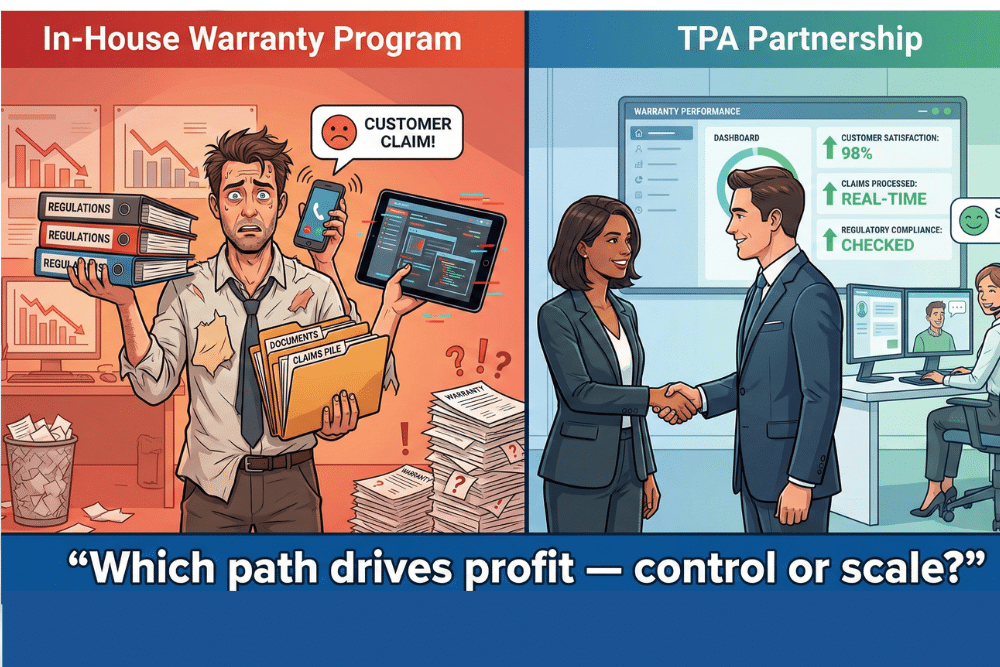
Do you control everything in-house — or scale faster with a TPA?
Let’s break down both paths, compare models, and help you make a smart, compliance-ready decision.
What’s at Stake — The Strategic Role of Warranty Delivery
Warranties are no longer an afterthought. They’re a core profit center, CX lever, and a powerful way to increase lifetime value (LTV).
But how you deliver the program — from coverage rules to claims processing — affects:
-
Brand trust
-
Revenue margins
-
Compliance risk
-
Customer retention
Choosing between in-house execution and third-party administration (TPA) shapes how fast you launch, how much you earn, and how customers experience your brand.
In-House Warranty Administration: Pros and Cons
In-house administration means your team owns:
-
The service contract infrastructure
-
The customer support experience
-
Claims logic and fulfillment
-
Regulatory compliance
✅ Pros:
-
Full control over the customer journey
-
Ownership of first-party data
-
Greater margin potential
-
Ability to innovate in-house
❌ Cons:
-
Licensing, training, and ongoing compliance risk
-
Technology investment (claim systems, dashboards)
-
Slower time to market
-
Legal exposure in multiple jurisdictions
Curious how to build your own operation? Start here:
👉 How to Start Your Own Warranty Program (Dealer)
Partnering With a TPA (Third-Party Administrator)
A TPA handles the “heavy lifting” — especially useful if you lack regulatory capacity or want to move fast.
They manage:
-
Claims adjudication
-
Coverage design and logic
-
Customer service
-
Compliance and licensing
-
Reporting and reconciliation
✅ Pros:
-
Fast go-to-market execution
-
Outsourced compliance + licensing
-
Experienced staff and systems
-
Predictable fixed costs
❌ Cons:
-
Less control over brand experience
-
Shared customer relationships
-
Revenue split with the TPA
-
Data may be siloed
Need to vet a partner? Read:
👉 How to Choose a White-Label Warranty Partner for Your Retail Brand
Comparing the Models: A Strategic Table View
| Factor | In-House | TPA |
|---|---|---|
| Customer Experience Control | Full | Partial |
| Compliance Burden | High | Low (outsourced) |
| Time to Launch | 3–6+ months | 1–3 months |
| Upfront Investment | High | Low to Moderate |
| Ongoing Profitability | Higher (if efficient) | Shared with TPA |
Embedded SaaS as a Hybrid Model
Today, many companies are opting for a middle path:
✅ Use a TPA backend, but control the frontend via SaaS-powered APIs.
With embedded warranty platforms like All Shield, you can:
-
Customize the experience
-
Own the brand and digital UX
-
Embed warranty logic in your CRM, POS, or eComm flow
-
Use TPA licensing + claims rails behind the scenes
This hybrid model offers speed, scale, and safety — without sacrificing customer loyalty.
Regulatory Considerations
Whether you run the show or partner with a TPA, you’ll need to stay compliant:
U.S. Requirements:
-
FTC warranty disclosures
-
Magnuson-Moss Warranty Act
-
Service contract laws (varies by state)
Related: FTC Warranty Disclosures 2025
Canadian Requirements:
-
FSRA licensing in Ontario
-
PIPEDA for data privacy
-
Quebec Bill 64 — full bilingual disclosures
What the Data Says: Profitability & LTV
Here’s what we’ve seen across dozens of programs:
-
In-house models can drive higher LTV — if you have infrastructure
-
TPAs unlock quick revenue without hiring or legal lift
-
Hybrid models allow you to brand the experience while outsourcing complexity
Read: How to Turn Warranties Into a Recurring Revenue Stream
Final Decision Checklist
Ask these before committing:
-
✅ Do we have the resources to manage claims, compliance, and CX?
-
✅ How fast do we need to launch?
-
✅ How important is brand control vs. operational speed?
-
✅ Are we selling across provinces or U.S. states with strict rules?
If you’re unsure, run a model audit with our team.
👉 Book a Warranty Strategy Review
All Shield helps OEMs, retailers, and dealers design compliant, customer-first warranty programs — in-house, white-label, or hybrid.
🔍 Let’s evaluate your readiness and recommend the best-fit model.