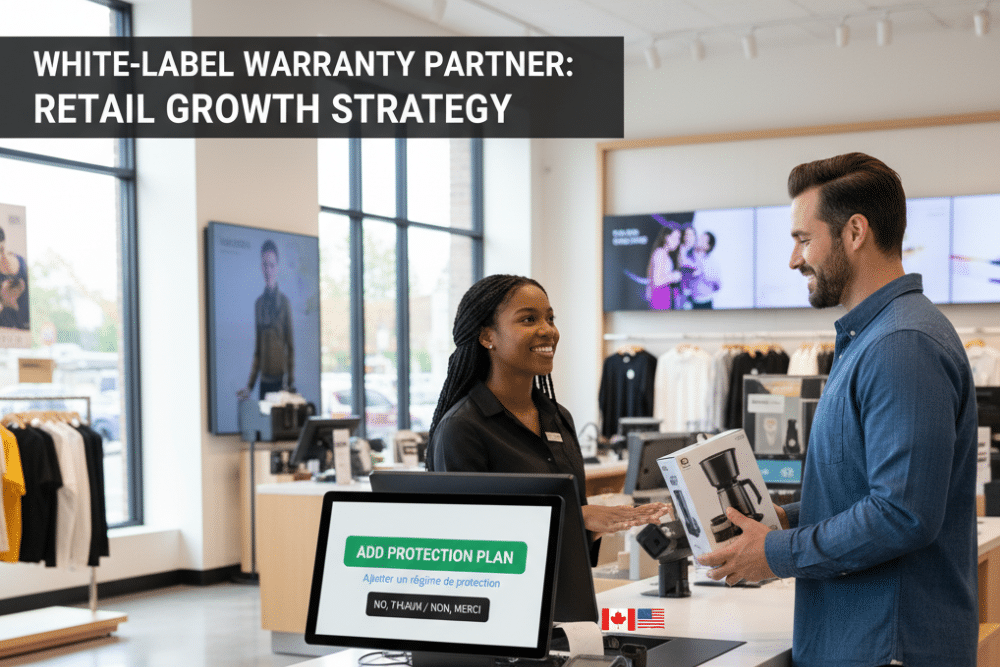
Retail Has Evolved—Your Warranty Strategy Should Too
Today’s retail environment demands more than great products. Consumers expect seamless post-sale experiences, including trustworthy product protection. In fact, over 60% now prefer to purchase warranties at the point of sale, whether online or in-store. This shift presents a major opportunity for retailers: build loyalty, increase lifetime value (LTV), and capture new post-sale revenue.
But to deliver those outcomes, you need more than a bolt-on warranty add-on. You need a partner who can embed protection directly into your brand—across every touchpoint, from POS to post-claim. This is where a white-label warranty solution comes into play.
Key Takeaways
-
A white‑label warranty partner must align with your brand, technology stack, and compliance requirements—not simply add your logo.
-
Embedded commerce‑ready tech + bilingual + audit‑ready infrastructure are non‑negotiables for U.S. & Canada retail brands.
-
The wrong partner erodes brand trust, reduces attach rates and can expose you to regulatory risk.
-
Ask focused questions across five dimensions: technology, compliance, claims experience, flexibility, and post‑sale revenue analytics.
-
Download the checklist and engage early with your partner vetting process to turn warranties into growth—not just protection.
| Feature | Ideal Partner Behaviour | Red Flag Behaviour |
|---|---|---|
| Integration & Technology | API‑first, POS/eCommerce ready, brand‑customizable UX | Legacy batch systems, inflexible UI, long integration timelines |
| Compliance Infrastructure | Supports PIPEDA, Bill 64 (CA), FSRA (ON), FTC (US) with bilingual flows + audit logs | No bilingual support, uses generic disclosures, lacks regional regulatory awareness |
| Claims Experience | Real‑time processing, branded notifications, self‑service dashboards | Manual claims backlog, disjointed communications, blurred brand experience |
| Program Flexibility | Control over terms, SKUs/rules, seasonal pricing, value‑add options | One‑size plans, no customization, fixed terms across product lines |
| Revenue Optimisation | Dashboards for attach rate, margin, renewal; supports A/B testing | No measurable analytics, zero data export, no optimisation roadmap |
Not All Warranty Providers Are Built for Retail Scalability
Many traditional warranty administrators were designed around insurance infrastructure—not modern retail workflows. Their platforms can be rigid, non-bilingual, slow to integrate, and confusing for consumers to navigate.
Common pain points include:
- Poor eCommerce integration
- Clunky, non-responsive warranty portals
- Inability to comply with FSRA, PIPEDA, or Quebec Bill 64
- Delays in claims resolution or approval
- Inflexible warranty rules that don’t match your SKUs
These issues do more than inconvenience customers. They can damage your brand’s credibility, reduce your attach rate, and create friction during the most vulnerable phase of the customer lifecycle.
Choosing the Wrong Warranty Partner Can Erode Brand Equity
Let’s look at the impact:
- A retailer in Quebec faced customer backlash after launching a warranty program that didn’t support bilingual flows, violating local compliance laws.
- A U.S.-based electronics chain saw attach rates decline by 17% after its claims process caused week-long delays.
- In both cases, the warranty experience weakened the customer relationship and created operational inefficiencies.
Brand trust is hard-won—and easily lost. In today’s experience-driven economy, your warranty partner is an extension of your brand. If their systems are outdated, their data isn’t secure, or their support is lacking, your reputation takes the hit.
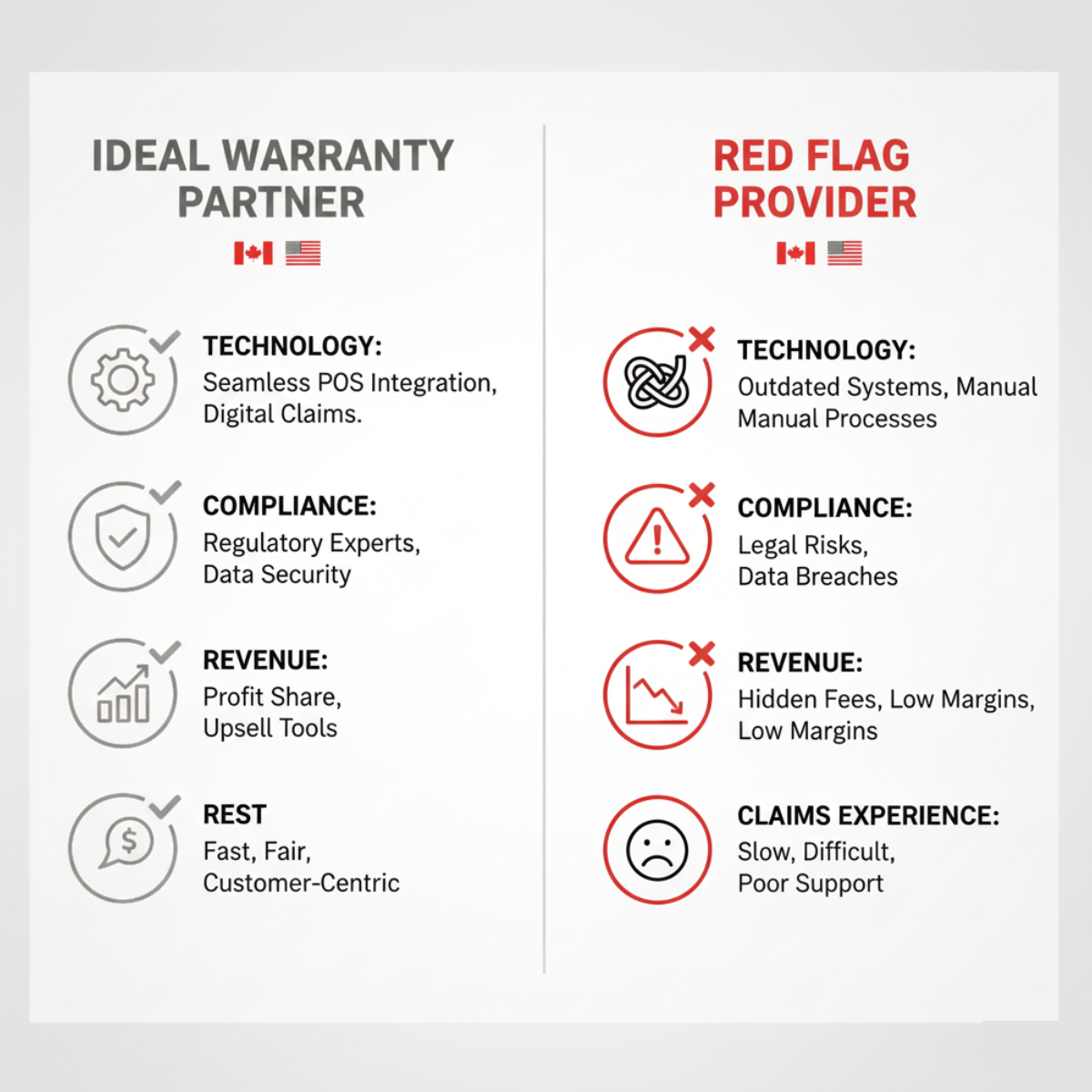
What to Look for in a Scalable White-Label Warranty Partner
Now that you know what to avoid, here’s how to evaluate potential partners:
1. Embedded Commerce-Ready Technology
Your partner should offer API-first architecture that integrates seamlessly with POS systems, eCommerce platforms, and ERPs. Bonus points for plug-and-play Shopify, Magento, or Salesforce compatibility.
Key questions to ask:
- Do you support real-time warranty pricing and registration at checkout?
- Can we customize the UX to match our brand’s look and feel?
📌 Related: Warranty API Integration – What B2B Product Leaders Need to Know
2. Compliance-Backed Infrastructure
Cross-border retailers face strict requirements. In Canada, your partner must support:
- PIPEDA for data privacy
- FSRA guidelines for service contracts
- Quebec’s Bill 64 for bilingual disclosures and consent
In the U.S., FTC warranty regulations and audit trails matter just as much.
Key questions to ask:
- Do you provide bilingual (en_CA/fr_CA) customer journeys?
- Can we access audit-ready compliance logs and documents?
📌 Related: Behind the Compliance – PIPEDA & Bill 64 Explained
3. Claims Experience That Builds Loyalty
Claims are the make-or-break moment in every warranty journey. Look for partners who offer:
- Real-time claims processing
- Digital self-service dashboards
- Branded claims notifications
Key questions to ask:
- What’s your average claims resolution time?
- Do you offer proactive claims updates or push notifications?
📌 Related: Consent-First Warranty Journeys – Trust Through UX
4. Warranty Program Flexibility
Your products aren’t one-size-fits-all—your protection plans shouldn’t be either. Seek partners who let you:
- Set your own terms, rules, and exclusions
- Tier your protection by category or price
- Offer value-added services (repairs, replacements, loyalty credits)
Key questions to ask:
- Can we create multiple warranty rule sets by SKU or region?
- Do you support seasonal or promotional warranty pricing?
5. Post-Sale Revenue Reporting & Optimization
Revenue from product protection can drive substantial margin lift—but only if it’s measured. Your partner should give you a performance dashboard with:
- Attachment rate by channel/SKU
- Claims cost vs. warranty margin
- Renewal and upsell performance
Key questions to ask:
- Can we export warranty performance data into our BI tools?
- Do you support A/B testing of coverage tiers or pricing?
📌 Related: How to Monetize Product Protection After the Sale
Red Flags to Watch Out For
If a provider can’t answer the questions above, they may not be ready to scale with your business. Other red flags include:
- White-label options that are just logo swaps (no control over UX or messaging)
- No bilingual support or limited Canadian compliance knowledge
- Lack of real-time integrations or batch-only processing
- Claims handled by third parties with no SLAs
Conclusion: Your Partner Should Extend Your Brand, Not Dilute It
The right white-label warranty partner should deliver three things:
- A fully branded customer experience
- Frictionless compliance in both the U.S. and Canada
- Tangible post-sale revenue opportunities
Retailers who treat warranty as a strategic growth channel—not a legal checkbox—stand to increase margins, boost retention, and own the post-sale experience.
Want to see how All Shield powers retail warranty programs across North America?
Book a Strategy Demo and get a personalized warranty revenue forecast for your product lines.
FAQs
Q1: What does white-label mean in the context of warranties?
A: It means the warranty program is branded as your own—your name, your rules, your customer journey—but powered by a partner behind the scenes.
Q2: Is it legal to offer white-label warranties in Canada?
A: Yes, as long as the partner complies with PIPEDA, FSRA, and Quebec Bill 64. All Shield supports full compliance.
Q3: How long does it take to launch a white-label warranty program?
A: With All Shield’s plug-and-play APIs, some retailers launch in under 30 days.
Q4: Can I customize the terms and coverage amounts?
A: Absolutely. All Shield lets you define terms, exclusions, durations, and pricing by product or region.
Q5: What does “white‑label” really mean in the context of warranties?
A: White‑label means you retain the brand identity—your name, your customer journey, your rules—while the infrastructure and operations are managed by a partner behind the scenes.
Q6: Can a retailer legally offer warranty/ protection plans in Canada and the U.S.?
A: Yes—but compliance matters. In Canada this means adhering to regulations such as Quebec Bill 64 (bilingual + data consent), PIPEDA (privacy) and provincial service‑contract rules (e.g., FSRA in Ontario). In the U.S., the Magnuson–Moss Warranty Act and FTC guidance govern disclosures.
Q7: How quickly can a white‑label warranty program launch?
A: With modern partners offering API‑first platforms and plug‑in integrations for POS/eCommerce, a launch within 30–60 days is feasible for many retail brands—assuming data, SKU mapping and compliance flow are pre‑aligned.
Q8: What metrics should retailers monitor to ensure warranty program success?
A: Key metrics include attach rate (% of transactions with warranty), claims cost vs premium margin, renewal/upsell rates, channel/SKU breakdowns, and customer satisfaction post‑claim.
Q9: What are typical attach rate benchmarks for retail warranties?
A: Industry data shows attach rates around 4.9% of product sales in some retail contexts. For premium or high‑value items (e.g., furniture) attach rates may hit ~50%.
Q10: What are common mistakes retailers make when choosing a warranty partner?
A: Mistakes include opting for a logo‑swap solution (little control), ignoring bilingual or regulatory requirements, lacking measurable analytics, neglecting claims UX, or failing to integrate with their POS/eCommerce systems.
Facts & Statistics
Market Context for Warranty Programs in North America
-
-
The global extended warranty market is projected to reach USD 159.38 billion in 2025, growing to USD 240.78 billion by 2030. Mordor Intelligence
-
In the U.S., the extended warranty market was valued at USD 48.38 billion in 2024 and is projected to reach USD 116.7 billion by 2033 (CAGR ~9.2%). IMARC Group
-
Approximately 60% of consumers said they would be more inclined to buy protection if offered a combination of coverage options (e.g., accidental damage plus shipping protection). covergenius.com
-
Some retail contexts report an attach rate of ~4.9% (product sales that include warranties) as of Q2 2024. Warranty Week
-
These statistics underline the growth potential and consumer readiness for warranty programs—making the selection of the right partner a strategic imperative.
Learn more: Glossary – Warranty Terms Explained
Unlock Deeper Insights: Expert Reports for B2B Warranty Leaders
Looking to scale revenue, streamline operations, or stay compliant across North America? These exclusive All Shield reports deliver actionable strategies for OEMs, retailers, and auto dealers. Whether you’re launching your first embedded warranty or optimizing an enterprise program, these downloadable guides offer the frameworks, benchmarks, and legal clarity you need to win the post-sale game. Dive into API integration, monetization tactics, privacy regulations, and more.