Whether you’re launching a new product line, managing post-sale experience, or looking to boost customer lifetime value, understanding how warranty programs work is essential.
This guide breaks down the structure, stakeholders, and economics of modern warranty models — designed specifically for OEMs, dealers, and retailers.
What Is a Warranty Program, Really?
A warranty program is a structured promise to repair, replace, or reimburse a product if it fails under specific conditions. It typically includes:
-
Coverage terms (duration, parts, labor, exclusions)
-
Claims process (customer flow and fulfillment logic)
-
Compliance (disclosures, registration, opt-in rules)
There are multiple types:
-
Manufacturer’s warranty (included)
-
Extended warranty (opt-in or upsold)
-
Service contract (third-party or white-label)
For a deeper breakdown of definitions and misconceptions, visit:
👉 What is an Extended Warranty? Definitions, Terms and Common Myths
How Warranty Programs Create Value
For OEMs
-
Brand trust: Shows commitment to product quality
-
LTV: Upsells via extended coverage and premium support
-
Data capture: Registration, usage, and claims analytics
For Dealers
-
Revenue: Add-on protection packages at point of sale
-
Service retention: Drives repair visits back to the store
-
CSI lift: Better customer satisfaction through quick issue resolution
For Retailers
-
Upsell leverage: Turns checkout into a profit center
-
Fewer returns: Customers are less likely to return if they feel protected
-
Embedded value: Bundled coverage increases perceived quality
Components of a Modern Warranty Stack
Legacy warranty processes — paper cards, phone support, PDF policies — no longer meet today’s customer or compliance standards.
Modern warranty programs use:
-
Embedded warranty APIs
-
Real-time product registration
-
Digital claims portals and automation
-
CRM and ERP integration
-
Multilingual compliance modules
Want to implement this fast? See: How to Launch a Warranty Program in 90 Days
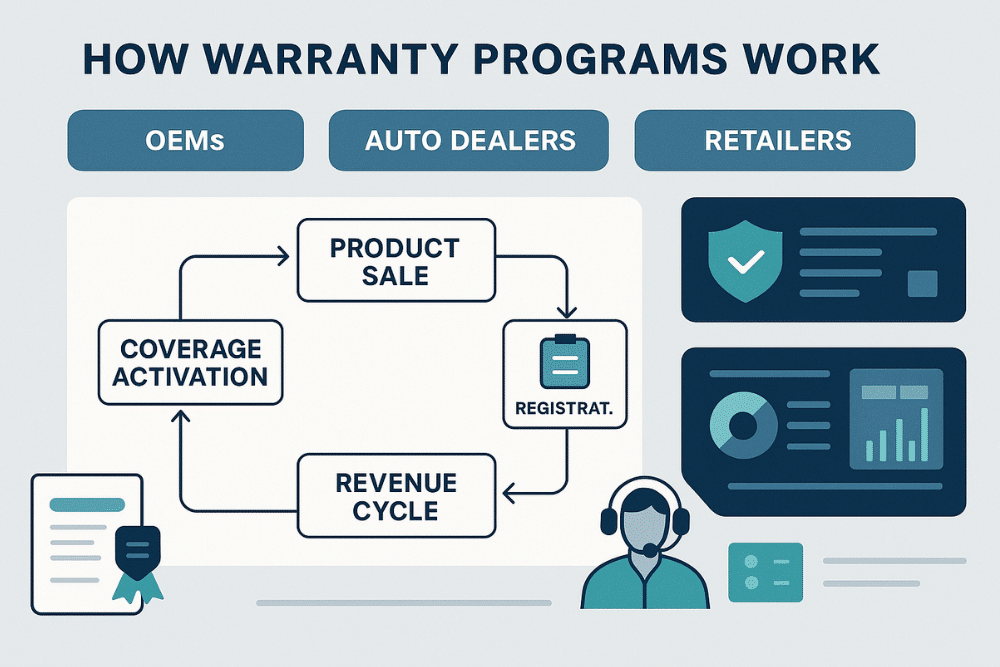
Step-by-Step: How Warranty Programs Work
Here’s how a typical warranty program functions behind the scenes:
-
Product Sold
Customer buys item online, in-store, or via dealer -
Warranty Offered
-
May be bundled (included)
-
Or presented as an opt-in at checkout/post-purchase
-
-
Registration Captured
-
Serial number, date of purchase, and customer info stored
-
Often via product page, QR code, or auto-fill API
-
-
Coverage Begins
-
Terms activate upon registration or delivery
-
Managed via SKU or product family
-
-
Claim Triggered
-
Online form, chatbot, or customer service intake
-
Claim evaluated → approved or denied
-
-
Resolution Fulfilled
-
Replacement shipped, repair scheduled, or reimbursement processed
-
All tracked for performance and compliance
-
How Money Flows in Warranty Programs
Warranty programs are often misunderstood as cost centers — but smart structuring turns them into predictable recurring revenue.
Financial Flow:
-
Customer pays (or warranty is bundled into product margin)
-
Warranty provider (you or a third party) assumes risk
-
Claims reduce margin, but only on a small percentage of units
-
Unclaimed reserves generate float, profits, or capital reinvestment
You can either:
-
Self-fund warranties (keep revenue + risk)
-
Partner with underwriters (share profit, offload liability)
Learn how to evaluate both in: How to Turn Warranties Into a Recurring Revenue Stream
Compliance Considerations for U.S. and Canada
🇺🇸 United States
-
Must comply with FTC Magnuson-Moss Warranty Act
-
Disclosures must be clear, accurate, and available pre-purchase
🇨🇦 Canada
-
FSRA regulates service contracts in Ontario
-
PIPEDA governs data captured via registrations or claims
-
Quebec Bill 64 requires bilingual warranty flows + data localization
If you’re targeting Quebec, make sure to have fr_CA translations and clear opt-in.
Which Warranty Model Is Right for You?
| Model | Who It’s Best For | Key Benefit |
|---|---|---|
| In-House Admin | Large OEMs with support infra | Full control over CX and margin |
| White-Label Program | Retailers, DTC brands | Brand-safe, hands-off execution |
| Embedded SaaS Warranty | eCommerce + connected devices | Real-time offers and CX data |
| Captive Insurance | Enterprise OEMs | Reinsurable structure and long-term risk management |
Start Building Your Warranty Program
Whether you’re selling smart home tech, power tools, consumer goods, or vehicles — the warranty is no longer just about risk. It’s about revenue, retention, and relationship.
All Shield helps OEMs, retailers, and dealers:
✅ Launch compliant warranty programs in under 90 days
✅ Embed real-time coverage into product or checkout flows
✅ Automate claims and track performance
✅ Choose self-funded, white-label, or underwritten models
🟢 Book Your Warranty Program Strategy Session
Get a personalized model aligned with your revenue, product, and CX goals.
👉 Request a Demo
FAQs
What is a warranty program?
A structured service contract that covers a product against defined failures, including repair, replacement, or reimbursement.
Who can offer warranties?
OEMs, dealers, and retailers can all offer warranties — either directly or through white-label providers.
Are warranties profitable?
Yes. When structured and priced properly, warranty programs generate high-margin recurring revenue, especially when tied to product registration and LTV.