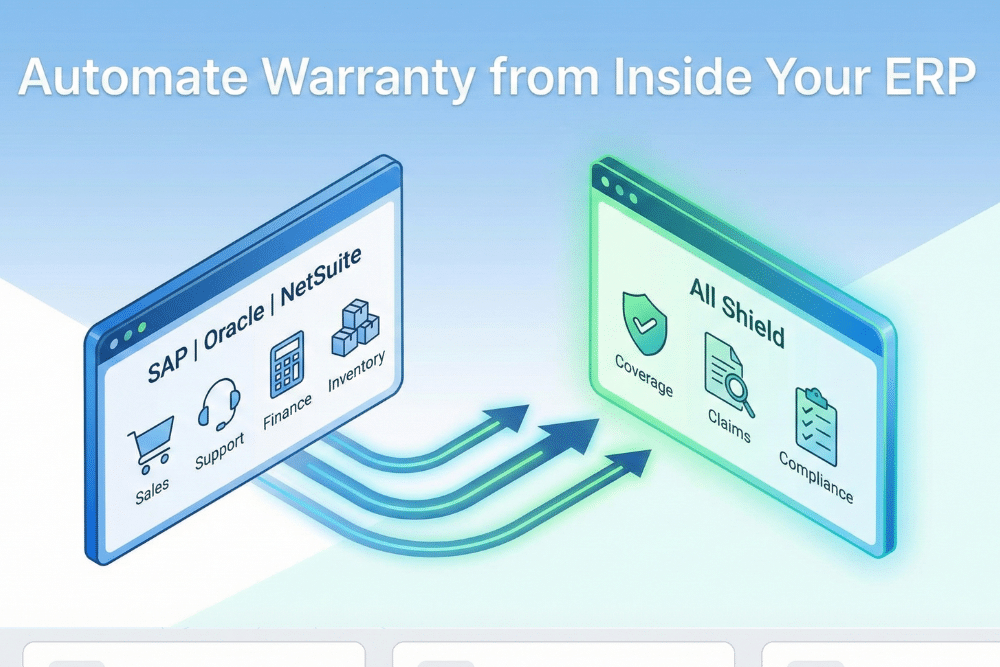
For manufacturers operating in today’s global, digitized, and compliance-heavy environment, the warranty process is often a bottleneck. From product registration to claims and renewals, many operations still rely on outdated, fragmented systems that leave teams frustrated and customers unsupported. Worse—these legacy workflows can cause compliance headaches and operational inefficiencies.
Warranty automation through ERP integration isn’t just a technical upgrade—it’s a strategic advantage.
By connecting your warranty programs to your ERP (Enterprise Resource Planning), you eliminate silos, unlock real-time insights, and deliver seamless customer experiences across the post-sale lifecycle. In this guide, we’ll explore how modern manufacturers are using platforms like SAP, Oracle, NetSuite, and Microsoft Dynamics in tandem with All Shield to modernize warranty administration.
Why Manual Warranty Management Fails Manufacturers
Despite advances in ERP and CRM platforms, many manufacturers still handle warranty data through spreadsheets, PDFs, and email chains. These manual approaches result in disjointed processes and make it difficult to:
-
Track warranty eligibility in real time
-
Route claims efficiently to the right teams
-
Analyze warranty trends for product improvement
-
Maintain audit-ready logs for compliance (e.g., FTC, FSRA, PIPEDA)
As warranty programs evolve into revenue engines and brand loyalty tools (read about **How to Monetize Product Protection After the Sale**), these gaps hurt both your customer experience and bottom line.
What Is Warranty Automation Within an ERP System?
Warranty automation refers to the real-time syncing of warranty workflows with your existing ERP infrastructure. Rather than treating warranty as an afterthought or standalone function, automation allows you to embed warranty logic into your core operational systems.
With a system like All Shield’s **Warranty API Integration**, you can:
-
Register warranties automatically from order data or SKUs.
-
Enable real-time coverage lookups by support and operations teams.
-
Automate communications to end-users (e.g., warranty confirmations, claim status).
-
Localize warranty terms to remain compliant across jurisdictions.
By linking warranty events to ERP modules (sales, support, finance), you reduce friction, improve clarity, and gain full visibility over warranty performance.
Supported ERP Systems and Integrations
All Shield has been built to integrate with leading ERP ecosystems. That means you don’t need to rip and replace your systems—you can automate warranties while keeping the backbone of your enterprise intact. Supported environments include:
-
SAP S/4HANA
-
Oracle Cloud & E-Business Suite
-
Microsoft Dynamics 365
-
NetSuite
-
Other Tier-2 or custom ERP platforms
All Shield’s middleware and native connectors ensure even hybrid or bespoke ERP stacks can support warranty automation. If you’re wondering how to connect, check out: “**Warranty API Integration: What B2B Product Leaders Need to Know**.”
Manual vs. Automated Workflows: A Side-by-Side Comparison
| Feature | Manual Workflow | ERP Warranty Automation (All Shield) |
| Claim Initiation | Email or forms | Triggered from sales/service modules |
| Data Sync | Disconnected systems | Synced across ERP, CRM, CX tools |
| Compliance Logs | Manual filing | Auto-logged, geo-compliant |
| Upsell / Renewals | Not tracked | Triggered at expiry / lifecycle events |
| Analytics & Reporting | Spreadsheet / manual reconciliation | Live dashboards and ERP-integrated reporting |
Use Case: Appliance OEM Automates Claims in NetSuite
One North-American appliance manufacturer using All Shield replaced their legacy warranty workflows with ERP-linked automation. Prior to integration, claims were filed through customer service portals and reconciled manually across departments—a slow, error-prone process.
After integration:
-
Orders triggered automatic warranty registration based on SKU and purchase data.
-
Returns and service modules were wired into warranty claim flows.
-
Support and operations teams could see warranty eligibility and claim history directly in their ERP dashboards.
Results included faster resolution times, higher warranty uptake, and fully compliant audit logs. For more on related services, see our **Appliance Warranty Administration** page.
Implementation: How to Get Started
ERP warranty automation doesn’t have to be a months-long overhaul. With All Shield, the process follows these steps:
-
Map your current warranty lifecycle and data flows.
-
Use All Shield’s middleware or API connectors for your ERP.
-
Define events, user roles, and workflows for warranties, claims, and renewals.
-
Test thoroughly with staging data.
-
Go live—and gain real-time visibility and control.
If you need help building a custom warranty program, our **Warranty Program Development** team is ready to help.
Compliance Built-In: North American Markets Covered
Whether you operate in the U.S. or Canada, compliance is non-negotiable. Manual warranty systems often fail here. All Shield supports:
-
FTC-aligned service contract disclosures.
-
PIPEDA-compliant data and consent management.
-
FSRA compliance for Ontario warranties.
-
Bilingual workflows for Quebec under Bill 64.
Find more in our dedicated **Compliance** hub.
Final Takeaway: Warranty Automation is the Future
Your ERP is the brain of your operations—warranty automation is the nervous system that keeps everything connected. When warranty, sales, service, and compliance flow through one integrated system, you unlock operational efficiency, unlock hidden revenue (as discussed in **How to Turn Warranties into a Recurring Revenue Stream**), and build trust with customers.
Ready to connect All Shield to your ERP? Contact us today and let’s show you what’s possible.
❓ FAQs
-
What ERP systems does All Shield support?
-
SAP, Oracle, Microsoft Dynamics, NetSuite, and many others.
-
-
How long does implementation take?
-
Most standard configurations can launch in 2–4 weeks.
-
-
Is this compliant in the U.S. and Canada?
-
Yes—All Shield supports FTC, PIPEDA, FSRA, and **Quebec Bill 64** compliance.
-
-
Can I view warranty data inside my ERP dashboard?
-
Yes—real-time coverage status, claims data, and analytics can be surfaced directly.
-
-
Will this reduce warranty admin costs and improve revenue?
-
Most clients see lower administrative overhead, faster claims resolution, and higher warranty adoption.
-