Yes, you can set your own warranty rules — but only if they are transparent, fair, and compliant with the law.
Whether you’re an OEM, a retailer, or an eCommerce brand, you have the flexibility to define what your warranty covers, how long it lasts, and how customers file claims. But that flexibility comes with boundaries: the rules must align with U.S. FTC standards, as well as Canadian compliance frameworks like FSRA, PIPEDA, and Quebec’s Bill 64.
“Brands can set their own warranty coverage rules — but the moment those rules become vague, restrictive, or deceptive, regulators step in. The key is transparency.”
All Shield
The Short Answer: Yes, But With Boundaries
Warranties aren’t one-size-fits-all. You can define coverage scope, exclusions, and even the claims process. But governments in North America enforce clear standards:
-
Transparency → Warranty terms must be written in plain language.
-
Fairness → You can’t void coverage for trivial reasons.
-
Compliance → Programs must align with FTC Magnuson-Moss rules in the U.S. and FSRA service contract regulations in Canada.
Failing to meet these standards risks fines, lawsuits, and even product delistings on major marketplaces.
What You Can Control
As a brand, you have the power to shape how your warranty works:
-
Coverage duration → Define length: one year, two years, or lifetime.
-
Scope of coverage → Decide if it includes parts, labor, or full replacement.
-
Claims process → Offer QR code activations, online portals, or dealer-based submissions.
-
Upsell potential → Provide extended warranties or service contracts at checkout.
This flexibility lets you design warranties that fit your product lifecycle and customer expectations.
What You Cannot Control
There are limits to what you can legally enforce:
-
❌ Denying valid claims without cause.
-
❌ Requiring only branded parts or services (illegal “tie-in sales” under the Magnuson-Moss Act).
-
❌ Refusing coverage for normal use failures.
-
❌ Ignoring bilingual requirements in Quebec.
-
❌ Using terms that make your program look like insurance, which requires a separate license.
These guardrails exist to ensure consumer protection and fair market practices.
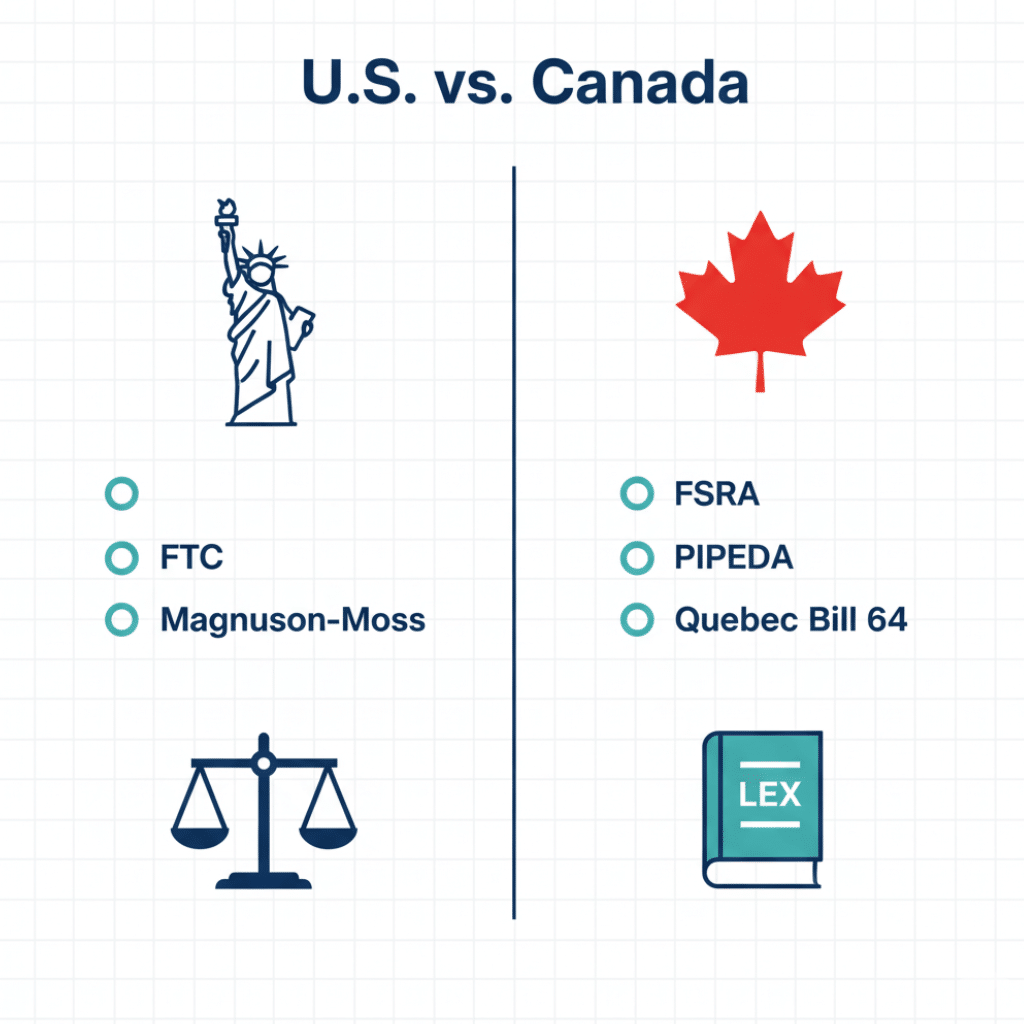
U.S. vs. Canadian Compliance Snapshot
United States
-
Governed by the Magnuson-Moss Warranty Act.
-
Requires plain-language disclosures.
-
Prohibits tying warranty validity to branded service or parts.
Canada
-
PIPEDA → Protects consumer data collected during product registration.
-
FSRA → Regulates extended service contracts in Ontario.
-
Quebec Bill 64 → Requires French-language disclosures and strict privacy compliance.
For brands selling cross-border, this means navigating both frameworks simultaneously.
Warranty Rule Flexibility vs Compliance Requirements
| Aspect | You Control It | Regulatory Boundaries |
|---|---|---|
| Coverage Duration | ✅ Yes | Must be disclosed clearly |
| Covered Components | ✅ Yes | Cannot exclude basic functionality |
| Claim Process | ✅ Yes | Must be accessible & reasonable |
| Exclusions (e.g., misuse) | ✅ Yes | Cannot be unfairly broad |
| Language of Terms | ❌ Limited | Must meet bilingual requirements in Canada |
| Insurance-Like Phrasing | ❌ No | Cannot imply risk transfer |
Common Mistakes Brands Make
Too often, companies get warranty rules wrong:
-
Writing overly broad exclusions that render coverage meaningless.
-
Failing to disclose terms clearly, triggering legal disputes.
-
Using generic templates that don’t adapt to regional laws.
-
Ignoring French-language compliance in Quebec.
-
Structuring programs so they resemble unlicensed insurance.
Each of these missteps damages trust and can attract regulator attention.
Best Practices for Setting Warranty Rules
Brands that succeed with warranties focus on three pillars:
-
Clarity → Use plain language. Customers shouldn’t need legal counsel to understand.
-
Specificity → Clearly define what’s covered, what’s excluded, and claim steps.
-
Flexibility → Offer multiple tiers: standard warranty + extended service contracts.
-
Automation → Use platforms like All Shield for API-driven compliance, bilingual templates, and automated claims.
“The most effective warranties are those that balance customer protection with business growth. Simplicity, fairness, and automation turn compliance into a competitive edge.”
All Shield
How All Shield Helps
All Shield makes warranty compliance simple while giving brands total control:
-
Pre-vetted templates that meet FTC, FSRA, and Quebec Bill 64 requirements.
-
White-label warranty platform → Your brand stays front and center.
-
API-driven integrations → Works with Shopify, Salesforce, NetSuite, POS systems.
-
Multilingual support → English + French for U.S. and Canadian markets.
Explore our Bespoke Warranty Programs to see how we help OEMs, retailers, and eCommerce brands launch compliant, revenue-driving warranties.
Conclusion
Yes—you can set your own warranty rules. But they must be clear, fair, and compliant. Done right, warranties are more than protection — they’re a revenue engine that boosts trust, retention, and post-sale growth.
Book a free strategy session with All Shield to design compliant, profitable warranty rules for your brand.
FAQ
Q: Can I decide how long my warranty lasts?
A: Yes. You can choose any duration, but it must be disclosed and reasonable.
Q: Can I exclude accidental damage?
A: Yes, but exclusions must be written clearly, not hidden in fine print.
Q: Do I need different rules for U.S. vs. Canada?
A: Yes. Laws differ, but All Shield ensures compliance across both regions.
Q: What happens if my rules are too restrictive?
A: You risk fines, lawsuits, and negative marketplace reviews.
Q: How do I simplify compliance?
A: Use a platform like All Shield that automates disclosures, manages claims, and ensures bilingual support.