The term extended warranty has evolved far beyond paperwork and sales counters.
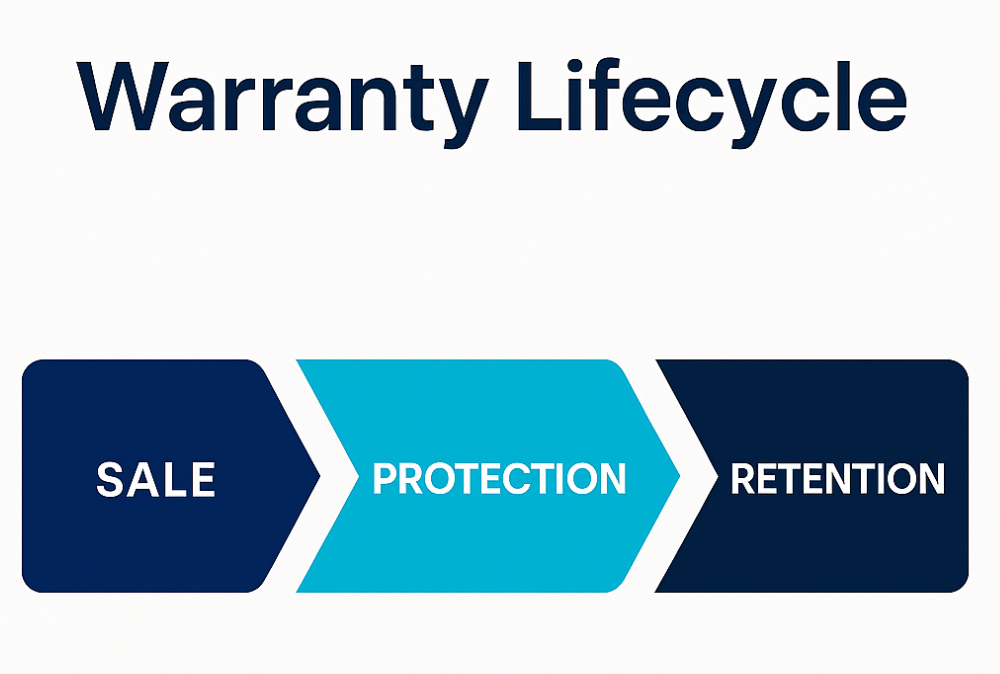
Today, it’s a key driver of customer trust, retention, and recurring revenue.
For retailers, manufacturers (OEMs), and eCommerce brands, extended warranties are no longer just “add-ons” — they’re a strategic business tool for post-sale engagement and lifetime value.
According to the 2024 Deloitte Consumer Loyalty Report, 88% of consumers are more likely to repurchase from brands offering transparent, easy-to-understand warranty programs.
Understanding Extended Warranties
An extended warranty is a paid service agreement that provides coverage beyond the manufacturer’s original warranty period. It may include additional repair protection, replacement coverage, or enhanced service levels.
Extended warranties differ from:
-
OEM (Manufacturer) Warranties: Provided by the product maker and included in the purchase.
-
Service Contracts: Third-party maintenance agreements that may go beyond basic warranty coverage.
-
White-Label Warranty Programs: Managed by a platform like All Shield, but fully branded for your business.
Reference:
The FTC’s Magnuson-Moss Warranty Act and FSRA of Ontario set the disclosure and compliance standards for extended warranties in North America.
The Core Types of Extended Warranties
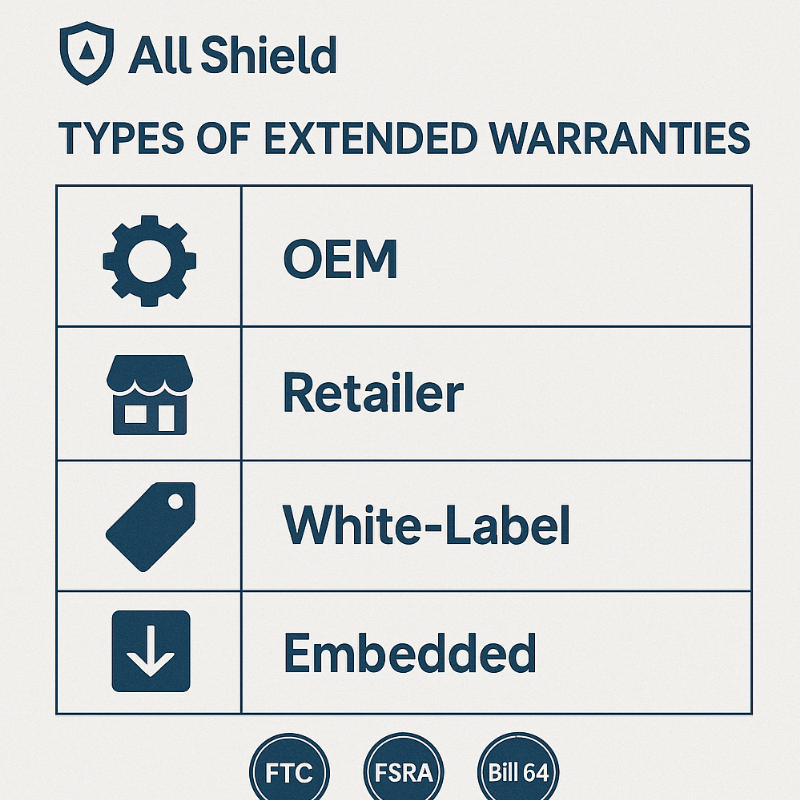
There are four main types of extended warranties, each with different ownership, branding, and compliance responsibilities.
| Warranty Type | Who Offers It | Branding | Duration | Example | Compliance Notes |
|---|---|---|---|---|---|
| OEM | Manufacturer | OEM | 1–3 years | AppleCare+ | FTC / FSRA |
| Retailer | Retailer / Distributor | Shared | 1–5 years | Best Buy Geek Squad | Consumer protection laws |
| White-Label | Powered by All Shield | Custom (your brand) | 1–5 years | “Peace of Mind Plan” | Automated (PIPEDA, FSRA, Bill 64) |
| Embedded / Subscription | OEM or Retailer | API-integrated | Ongoing | Checkout add-on | Digital warranty disclosure standards |
With All Shield, companies can manage all of these models—OEM, white-label, and hybrid—within a single, API-enabled platform.
What Extended Warranties Usually Cover
Extended warranties typically include:
-
Mechanical and electrical failures
-
Parts and labor coverage beyond the original term
-
Optional accidental damage protection
-
On-site or depot repair
-
Transferable and refundable terms
Learn more: How to Offer Product Warranties as a Retailer or OEM
Common Myths About Extended Warranties (and the Truth)
-
Myth 1: “Extended warranties are just profit traps.”
- Truth: When structured transparently, they increase customer trust and repeat purchases.
-
Myth 2: “They only benefit the seller.”
- Truth: Data shows customers who purchase extended warranties have 30–40% higher LTV due to retained engagement and satisfaction.
-
Myth 3: “All warranties are the same.”
- Truth: Coverage and compliance vary widely. With All Shield, programs are customized per product, region, and regulation.
-
Myth 4: “They’re hard to integrate online.”
- Truth: All Shield’s warranty API makes digital add-ons plug-and-play across eCommerce and POS systems.
Key Warranty Terms You Should Know
| Term | Definition |
|---|---|
| Term Duration | Length of extended coverage beyond OEM warranty |
| Waiting Period | Time before coverage takes effect |
| Exclusions | Conditions not covered (wear & tear, misuse) |
| Transferability | Option to transfer warranty when reselling |
| Cancellation / Refund | Rules governed by FTC, FSRA, and Quebec Bill 64 |
Extended Warranty Myths for Businesses
-
“Only big brands can offer extended warranties.”
-
False — White-label models make it accessible for all.
-
-
“It’s too complex to manage.”
-
False — Automation platforms like All Shield handle claims and compliance.
-
-
“You need an insurance license.”
-
False — All Shield partners with licensed administrators, ensuring compliance.
-
-
“They don’t affect retention.”
-
False — Brands using All Shield report a 7–9% increase in LTV.
-
How Extended Warranties Drive Business Growth
-
Revenue: Warranty attach rates generate new profit channels.
-
Customer Retention: Keeps customers engaged post-sale.
-
Data Intelligence: Claims data informs product improvements.
-
Differentiation: Adds perceived product value.
Case Insight:
A Canadian electronics retailer using All Shield’s white-label warranty increased warranty attach rates by 41% and customer satisfaction by 32% in one quarter.
How All Shield Helps You Offer Extended Warranties
All Shield is North America’s most advanced B2B warranty platform, enabling manufacturers, retailers, and service providers to build branded, compliant warranty ecosystems.
With All Shield, you can:
-
Manage OEM, white-label, and extended warranties in one system
-
Integrate warranty APIs with your CRM, POS, or eCommerce site
-
Ensure PIPEDA, FSRA, and Quebec Bill 64 compliance
-
Offer bilingual customer portals (EN/FR)
-
Automate claims, renewals, and analytics
Explore All Shield’s Warranty API Integration Guide
Key Takeaways
-
Extended warranties build trust, retention, and recurring revenue.
-
They can be offered by OEMs, retailers, or as white-label programs.
-
The best programs combine brand control with automation.
-
All Shield makes warranty management simple, compliant, and scalable.
FAQ: Extended Warranties Explained
1. What’s the difference between a warranty and a service contract?
A warranty is a legal guarantee; a service contract is a paid extension.
2. Do extended warranties require licensing in Canada?
All Shield’s programs comply with FSRA and PIPEDA regulations, so you don’t need to manage licensing directly.
3. How can I measure ROI from warranties?
Use attach rate, claim rate, and LTV lift metrics—automated via All Shield analytics.
4. Can extended warranties be bilingual under Bill 64?
Yes — All Shield provides bilingual templates (EN/FR) for Quebec compliance.
5. Which industries benefit most?
Appliances, electronics, automotive, furniture, and commercial equipment.
6. How long does setup take?
Most white-label warranty programs launch within 30–45 days.
Ready to Extend Your Brand’s Protection?
All Shield helps OEMs, retailers, and service providers launch scalable, bilingual extended warranty programs across North America.
1 888 406 4545
contact@allshield.co
1275 North Service Road W, Suite 605, Oakville, ON L6M 2W2
Book a Demo | Explore Warranty Solutions