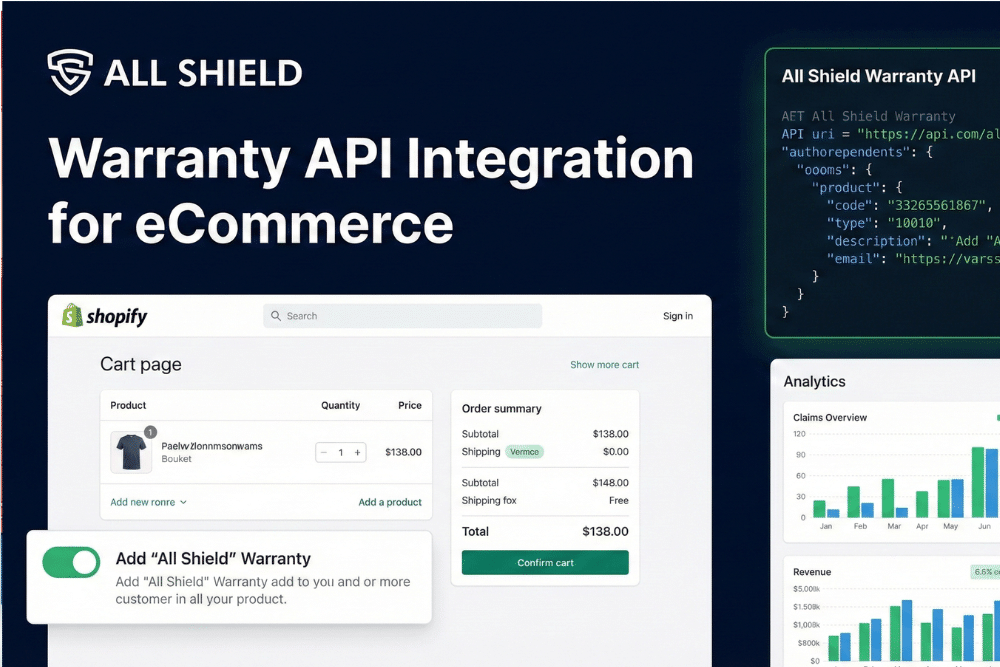
Integrating Warranty APIs Into Your eCommerce Stack: A Practical Guide
In today’s competitive eCommerce landscape, the sale doesn’t end at checkout. For digital-native brands and online retailers, offering seamless product protection has become a new lever for customer retention, upsell revenue, and long-term brand loyalty.
But how do you move beyond clunky, legacy warranty systems? Enter: Warranty APIs. These flexible integrations make it possible to offer, manage, and track warranties in real time—without leaving your platform.
This guide shows how to embed warranty APIs into your eCommerce tech stack to unlock post-sale revenue and better customer experiences.
| Feature | Value to eCommerce Brands | All Shield Advantage |
|---|---|---|
| Real-Time Integration | Embedded warranty offers at checkout | Plug-and-play for Shopify, WooCommerce, custom stacks |
| Brand Customization | White-label experience for trust and consistency | Flexible UI modules + API-led styling |
| Claims Automation | Streamlined CX and lower support costs | Real-time claim status, multilingual portals |
| Regulatory Compliance | Reduces legal exposure in U.S. and Canada | Built-in support for PIPEDA, FSRA, FTC, Bill 64 |
What Is a Warranty API and Why eCommerce Brands Need One
A warranty API allows retailers and DTC brands to embed product protection directly into their existing platforms. Rather than redirecting customers to a third-party portal, everything from purchase to claim is handled within your environment.
Key Benefits:
- Embedded at checkout for real-time upsell
- Customizable terms and branding
- Seamless claim initiation and tracking
- Works with Shopify, Magento, WooCommerce, and custom stacks
Warranty APIs are especially valuable for high-ticket items like electronics, furniture, appliances, and fitness equipment.
Common Challenges of Post-Sale Warranty Management
Traditional warranty programs are often:
- Disconnected from the shopping experience
- Manual in their registration and claim processes
- Insurance-heavy, with compliance friction
These pain points lead to low attach rates, poor customer experiences, and missed revenue opportunities.
Core Features of an eCommerce-Ready Warranty API
A robust warranty API should include:
- Real-time warranty status tracking
- Dynamic upsell triggers during checkout or post-purchase
- White-label interfaces that match your brand
- CRM, ERP, and fulfillment integrations
- Multilingual support (for Canada: English + French)
- Regulatory compliance (FTC, PIPEDA, FSRA, Quebec Bill 64)
How to Choose the Right Warranty API Partner
Look for a provider that offers:
- Developer-friendly documentation
- Prebuilt connectors for Shopify, Amazon, Salesforce, etc.
- Custom coverage modules based on product type
- Onboarding support and analytics dashboards
- Proven compliance infrastructure across U.S. and Canada
Step-by-Step: Integrating a Warranty API into Your Stack
Step 1: Define Your Warranty Rules
- Term length, coverage limits, exclusions
Step 2: Authenticate the API
- Use OAuth or token-based access
Step 3: Map Customer Events
- Checkout, order confirmation, support tickets
Step 4: Embed Warranty UI
- Modals, offer cards, customer dashboards
Step 5: Test Thoroughly
- Use staging environments to simulate real transactions
Shopify, Amazon & Headless: Integration Variations
Shopify: Use prebuilt apps or Liquid-based widget placement.
Amazon Sellers: Leverage All Shield’s embedded warranty for FBA with API event hooks.
Headless Commerce: Middleware architecture allows full control across frontend/backend interactions.
How to Track Warranty Performance Post-Integration
Use a real-time analytics dashboard to track:
- Attach rate (how many customers add a warranty)
- Claim rate and resolution time
- CX metrics (NPS, support tickets)
- Revenue from warranty upsells
Future-Proofing: What’s Next in Embedded Warranty Tech
- Predictive warranty pricing based on product and customer behavior
- AI-driven claim adjudication
- LTV optimization through dynamic offer sequencing
Final CTA: Ready to See a Live Warranty API Integration?
Book a personalized demo with All Shield’s developer success team. Or download our API documentation pack to explore what’s possible.
FAQs
1. What is a warranty API integration?
A backend system that allows you to offer, register, and manage warranties natively inside your eCommerce platform.
2. Can I offer warranties on Shopify or Amazon?
Yes. All Shield supports plug-and-play apps and API-based custom setups.
3. How long does integration take?
Typically 1–2 weeks for standard setups. Custom configurations may vary.
4. Is the system bilingual and compliant in Canada?
Yes. We support French/English parity and align with PIPEDA, FSRA, and Bill 64.
5. What kind of analytics do I get?
Full warranty lifecycle tracking: attach rate, claims, revenue, CX scores.