
What Retail Executives Need to Know About Behavioral Economics in Warranty
In today’s retail landscape, offering a warranty program is no longer just about customer protection—it’s about smart revenue, deeper loyalty, and differentiated value. But even the best warranty plans underperform if they ignore one thing: human behavior.
Consumers rarely act like textbook economic agents. In fact, behavioural economics tells us that decision‑making is often emotional, intuitive, and context‑dependent. For warranty programs, that means how you frame, position and structure your offering can dramatically shift attach rates, renewals and customer trust.
In this article you’ll discover:
-
Why many warranty programs fall flat despite good terms
-
How key behavioural levers such as defaults, anchoring and loss‑aversion apply to warranties
-
Practical tactics retail execs can apply immediately
-
A compelling offer to transform your warranty strategy into a growth engine
Why Smart Warranty Programs Aren’t Just About Protection
Here’s a scenario: A major electronics chain rolled out a premium warranty plan with strong labor/parts coverage and no deductible. Yet the attach rate — the percentage of transactions with a warranty added — stayed stubbornly under 5%. Why?
Because even when the value is clear, humans don’t always make decisions in purely rational ways. They rely on shortcuts, status quo bias, emotional cues, and perceived risk. Behavioural economics shows that how your warranty is offered often matters more than what you’re offering.
According to a 2012 study by Oxera, only about 25% of consumers shopped around for an extended warranty and 71% bought it at the same time they purchased the product. In other words, the moment of decision is critical—and so is the architecture of the choice.
For retail brands aiming to turn warranties from a side offer into a strategic upsell, framing, positioning and behavioural cues are indispensable.
Engage – The Hidden Psychology Behind Warranty Decisions
Loss Aversion – People Hate Losing More Than They Like Gaining
When a buyer sees “Add Protection Plan – only $79”, it feels like a gain. But when you frame it as “Avoid $299 repair cost” you’re tapping into loss aversion—the idea that people are more motivated to avoid a loss than to secure a gain. Studies show this bias plays a key role in warranty decisions.
Default Bias / Status‑Quo Bias
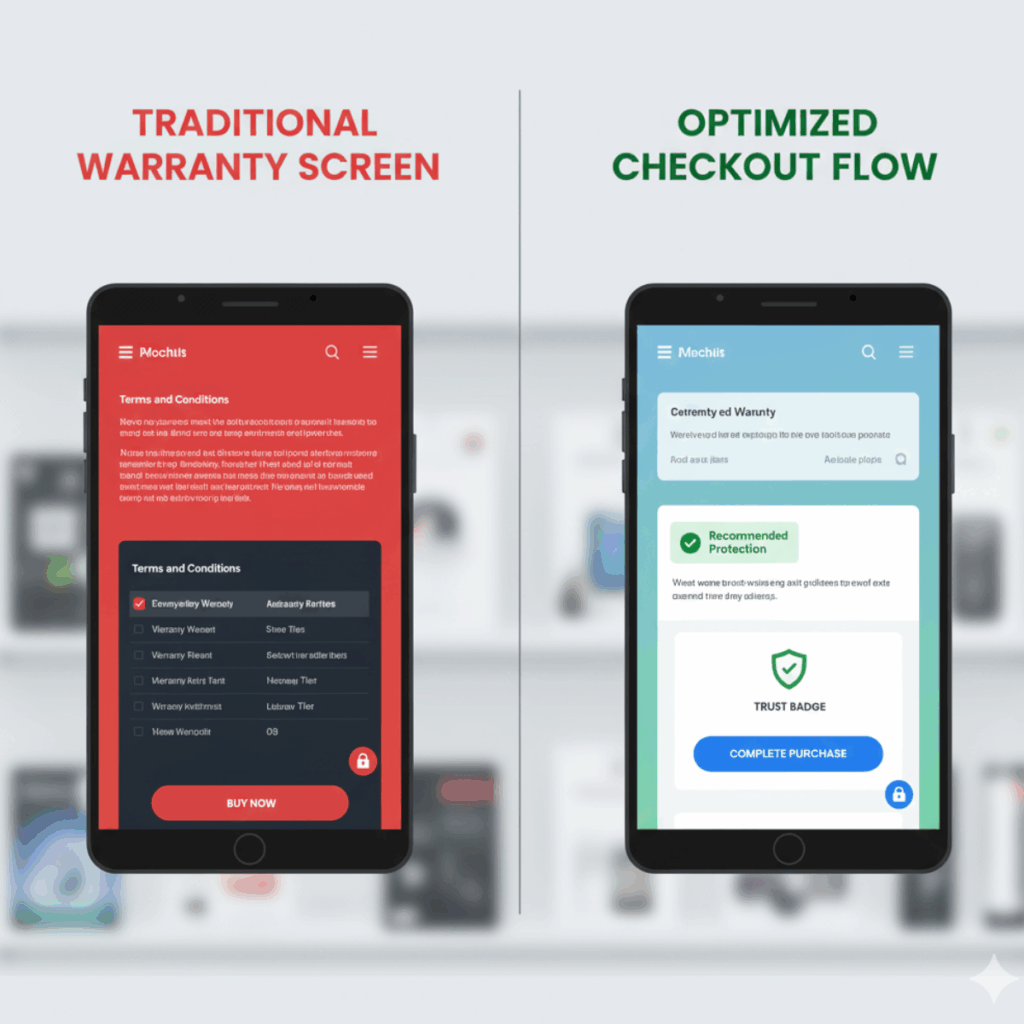
If a warranty option is pre‑checked or clearly labelled as “Recommended”, many consumers take it without thinking. That default setting reduces friction and drives higher adoption. Retailers can embed this into the checkout or “Add coverage” layer.
Anchoring & Decoy Pricing
Placing a high‑tier warranty plan next to your standard warranty plan helps anchor expectations. Consumers perceive the standard plan as good value. This behaviour is well‑documented in retail experiments.
Framing & Choice Architecture
Whether you say “Protect your purchase” or “What happens if this breaks?” changes perception. Offering too many choices can reduce conversion (choice overload). Simplifying options improves attach rate and satisfaction.
Endowment Effect & Ownership
Once customers feel that coverage is “their right” or already theirs (e.g., “Your device already has protection—upgrade now”), they assign higher value to it. This principle underscores why promotional pre‑coverage or automatic “included for first 30 days” offers work.
Reveal – How Retailers Can Apply These Insights
Here are practical tactics you can deploy right now to optimise your warranty program.
Embed Warranty at the Right Moment
Offer the warranty during checkout or at the moment of product registration—not after. A 2023 study by Wiley found that consumers are more likely to buy warranty if it is presented before purchase completion.
Use Tiered & Anchored Options
Structure your warranty plans like price‑tiers:
-
Basic: 12‑month additional coverage
-
Premium: 24‑month + accidental damage
-
Elite: 36‑month + same‑day on‑site service
The presence of a high‑tier “premium” plan makes your base plan look like a better deal.
Frame Messaging Using Loss Aversion
Use language like “Don’t risk a $450 repair” or “Protect your investment” rather than simply “Buy this plan”. Move the conversation from “gain” to “avoid loss”.
Simplify Choice & Leverage Defaults
Pre‑select the “Recommended” plan and grey out lesser options. But allow choice reversal. Make the process transparent to build trust.
Use Bilingual & Trust‑Led UX for Canada
In bilingual markets like Québec, offering both English and French options reduces friction, builds trust and aligns with regulatory needs (e.g., Bill 64). See our article on bilingual flows.
Provide Social Proof & Simplify the Risk
Add statements like “Over 90% of buyers said they’d buy again” or “X claimed in under 24 hours”. These reduce perceived risk and match behavioural cues of trust.
Use Data & Analytics to Improve Design
Track:
-
Attach rate by SKU, channel and plan
-
Bounce rate from warranty offer pop‑up
-
Renewal rate, upgrade rate
Use A/B testing: try default‑checked vs non‑checked, change color/position of CTA, adjust plan wording.
Offer – Where to Start (and What to Avoid)
Start here:
-
Conduct a behavioural audit: map the journey where coverage is offered, identify friction points.
-
Run a minimalist A/B test: default‑check vs blank checkbox.
-
Review your choice architecture: reduce plans to 2–3, simplify language.
-
Update your promotional language to emphasise protection, not extension.
Avoid these mistakes:
-
Offering more than 4 plans—choice overload kills conversion.
-
Using jargon like “Extended Protection Plan (EPP)” without clarity.
-
Placing the warranty offer after delivery or confirmation—too late.
-
Ignoring bilingual UX or regional compliance—costs trust and conversions.
Contact All Shield
Ready to turn behavioural insights into revenue? Book a Warranty Behaviour Audit with All Shield today. We’ll help you redesign your purchase flow, frame your warranty offer, and boost attach rate—while staying compliant in both U.S. and Canada.
Schedule Your Strategy Demo — Uncover the behavioural levers your warranty program needs.
FAQs
Q1: Can behavioural economics really increase warranty attach rate?
Yes. Behavioural levers like defaults, anchoring and framing have been shown in academic and industry studies to influence decision‑making and increase add‑on take‑rates.
Q2: Are there legal risks if I use behavioural design in warranty offers?
Only if the design mis‑leads or hides information. All Shield recommends transparency and compliance: clear disclosures, easy opt‑out, bilingual support (Canada), and avoiding coercive defaults.
Q3: What behavioural tactic is most effective for warranty programs?
Framing loss (what you might pay if no coverage) and using a recommended default both rank highly. Choose what fits your brand and channel.
Q4: How many warranty plan options should I offer?
Ideally 2‑3 tiers. More than that risks choice overload and lower conversions.
Q5: Does this apply differently in online vs physical retail?
Yes. In‑store you can use default‑checked offers at POS; online you can optimize placement, colour of CTA, framing copy and timing (pre vs post purchase). The principles remain the same.
Q6: How do we measure behavioural changes in warranty uptake?
Track attach rate, plan choice distribution, checkout abandonment, renewal/upgrade uptakes, and A/B test variations of offer design.
Key Takeaways
-
Behavioural economics reveals decision‑drivers like defaults, loss aversion, anchoring and simplified choice that heavily influence warranty uptake.
-
Framing the conversation about “protection” and “avoid cost” rather than just “add coverage” drives better results.
-
Retail executives should audit their warranty purchase flow, simplify choices, apply behavioural levers, and track performance.
-
With thoughtful design and compliance alignment (including bilingual UX and regional regulation), warranty programs become growth vehicles—not just add‑ons.