Designing Smart Warranty Programs for Commercial Equipment
Capital equipment—whether heavy machinery, industrial systems, or B2B infrastructure assets—demands a different approach to warranty design than consumer products. These are high‑value, long‑lifecycle assets with complex ownership, service, financing, and regulatory implications. At All Shield, we’ve helped OEMs and equipment manufacturers across North America turn warranties into strategic profit centers—not cost centers.
In this guide, you’ll gain the clarity to:
-
Identify the unique requirements of B2B capital‑goods warranties.
-
Develop a scalable warranty program tailored to your business model.
-
Communicate the compliance, service and analytics elements that matter.
-
Ask the right questions when choosing a partner (or building in‑house).
What to Look for in a Commercial Equipment Warranty Partner
| Feature | Ideal Partner Behaviour | Red Flag Behaviour |
|---|---|---|
| Integration & Technology | API‑first, ERP/FSM-ready, customizable UX | Batch uploads, inflexible tools, long dev cycles |
| Compliance Infrastructure | Bilingual (en_CA/fr_CA), PIPEDA, FSRA, FTC‑ready | No audit trail, no localization, lacks awareness |
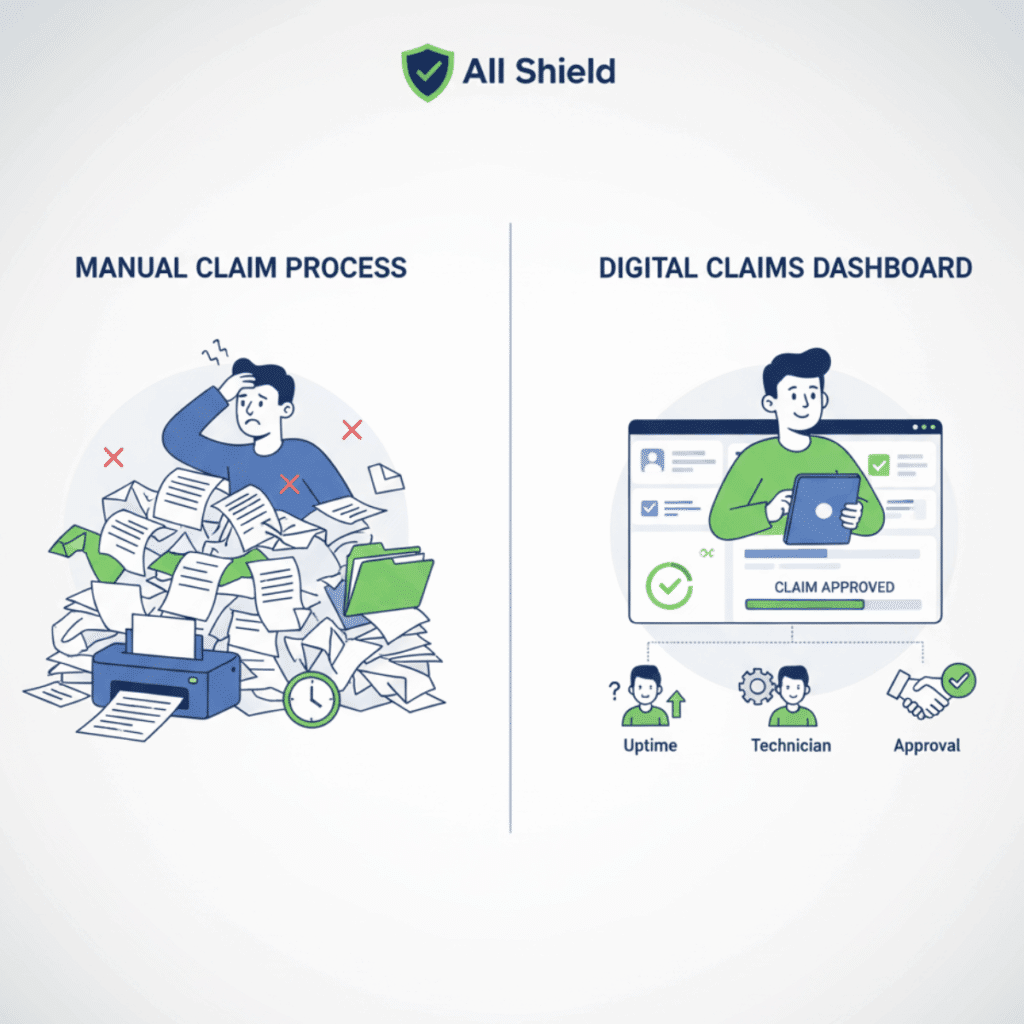
| Claims Experience | Real-time tracking, on-site dispatch, mobile UX | Manual forms, no SLA, poor communication |
| Program Flexibility | Custom rules by SKU, term, usage, resale tiers | One-size-fits-all, limited coverage logic |
| Analytics & Revenue Optimization | BI export, attach rate, claims vs margin dashboards | No visibility, static PDFs, zero testability |
Identify – What Makes B2B Capital‑Goods Warranty So Unique?
High Value, Long Lifecycle
Unlike consumer electronics with 1–3 year life cycles, capital equipment often runs 5‑10+ years (or more). This extended lifecycle requires warranty coverage that accommodates wear, service, usage and evolving parts/technology. One industry commentary notes: “A warranty is like health insurance… When you bid for capital equipment you should weigh how long the warranty is and how responsive the vendor will be.”
Ownership Complexity
In B2B setups, equipment may be leased, operator‑owned, used in multiple sites, transferred to resale, or part of a service contract. The warranty program must handle transfers, multi‑user access, dealer channels and even capital‑asset financing.
Integration with Service & Financing Models
Warranty for capital goods often ties into maintenance contracts, leasing/financing, performance guarantees and service‑level agreements (SLAs). A program that ignores these overlays risks misalignment with the business model. As one advisor states: selling to the installed base is key for OEM aftermarket growth.
Develop – Core Components of a Scalable Commercial Warranty
Term Length & Usage‑Based Tiering
Because equipment runs longer, your warranty program needs flexible term lengths (3‑5 years or more), usage‑based tiers (hours/miles), and adjustment for high‑utilization assets. Coverage must reflect real risk, not standard consumer models.
Transferability & Secondary Market
Many capital goods are traded, resold, or repurposed. Warranty programs that support transferability—so the next owner benefits—generate higher resale value and enhance brand reputation.
Claims Logistics & Parts/Service Network
High‑value equipment breakdowns carry heavy cost-of-downtime. Your warranty must include on‑site service, priority parts shipping, technician dispatch, and remote monitoring. A strong program example outlines coverage of engine, transmission, hydraulics, with day‑one coverage and live claims via mobile app.
Integration with Digital Data & Analytics
Modern capital equipment is increasingly connected. Warranty programs should leverage telematics, usage sensors and predictive maintenance data to reduce claims and shift from reactive to proactive service.
Pricing & Risk Structure
From an actuarial viewpoint, long‑life capital warranties require deeper risk modelling: frequency × severity, usage intensity, parts obsolescence, service‑history trends. The pricing also needs to align with your margin objectives, not just cover cost.
Communicate – Risk, Compliance & Data Considerations
Regulatory Landscape – U.S. & Canada
In Canada, data‑privacy regulation (Personal Information Protection and Electronic Documents Act / PIPEDA), bilingual disclosures (Quebec Bill 64) and financial‑services regulation (Financial Services Regulatory Authority of Ontario – FSRA) matter. In the U.S., agencies like the Federal Trade Commission (FTC) govern warranty disclosures and service‑contract compliance.
Ensure your partner or in‑house team supports audit‑ready logs, bilingual customer journeys (en_CA/fr_CA) and enterprise‑grade data security.
Service Contract Lifecycle & Aftermarket Growth
Warranty programs for capital goods don’t stop at the initial sale—they evolve with service, renewal, upgrades, and resale. One review highlights the three lifecycle events of a B2B service contract: initial sale, modify coverage, renew contract. Understanding these stages helps you design renewal and upsell models.
Using Analytics to Build Value
Communicate how warranty data—claims, failure modes, maintenance events—feeds back into product improvement, customer retention, and profitability. For example: converting variable cost of breakdowns into predictable fixed cost via longer warranties generates competitive advantage.
Ask – What to Look for in a Capital‑Warranty Partner
Custom Terms & Equipment‑Specific Rule Sets
-
Can the partner support multiple rule sets by equipment type, region, usage intensity?
-
Can you define exclusions, deductibles, usage caps?
-
Is the UX fully branded to your company, not generic?
Integration & Digital Platform
-
Do they provide API‑first architecture to integrate with your ERP, field service system, dealers?
-
Does the portal support self‑service, multi‑site entitlements, transferability?
-
Is the platform bilingual for Canadian usage?
Compliance, Audits & Branding
-
Do they maintain audit logs, data‑privacy certifications, bilingual customer journey (en/fr‑CA)?
-
Are they familiar with FSRA/FTC rules for service contracts?
-
Do they align warranty operations with your brand values and service expectations?
Analytics & Revenue Optimisation
-
Do they provide dashboards showing attach rate, claims ratio, renewal rates, margin by equipment class?
-
Can you test different coverage tiers, pricing models, or service bundles?
-
Can you export data into BI tools for broader enterprise insight?
Service Network & Claims Performance
-
Average claims resolution time? Availability of on‑site service?
-
Do they support remote diagnostics, IoT integration, scheduled maintenance?
-
How is downtime measured and penalised or guaranteed?
Contact
Ready to turn your warranty program from cost centre into a growth engine? Book a Commercial Warranty Strategy Call with All Shield today. We’ll map your asset portfolio, design rule sets, and provide a tailored revenue‑forecasting model—including bilingual compliance and North American regulatory alignment.
Schedule Your Strategy Demo — Let’s make your protection program work as hard as your equipment does.
FAQs
Q1: How does a commercial equipment warranty differ from a consumer warranty?
A: Commercial warranties are higher‑value, longer‑term, usage‑based, often tied to asset financing, service contracts, transferability, and multi‑site usage—versus the standard 1–3 year consumer model.
Q2: Can a warranty be transferred when equipment is resold?
A: Yes. A well‑designed program supports transferability, value‑add resale benefits, new owner registration, and often enhances resale value by documenting service history and coverages.
Q3: Are extended warranties for capital goods cost‑effective?
A: When structured properly, yes. They convert variable downtime and maintenance costs into predictable fixed cost, improve uptime, and support resale value—especially when usage and failure data are well‑managed.
Q4: What should I ask a warranty partner about analytics?
A: Ask for dashboards showing attach rate, claims cost vs margin, renewal rates, usage‑based triggers, and the ability to export data into your BI/ERP systems.
Q5: Do Canadian regulations like Bill 64 affect commercial warranties?
A: Yes—especially when the program crosses Quebec or involves data processing. Bilingual disclosures, customer consent, data residency and FSRA licensing may apply. Ensure your partner is fully compliant.
Q6: How long does it take to launch a white‑label commercial equipment warranty program?
A: With modern platforms and pre‑built integrations, some brands launch in 45–90 days. Timeline depends on asset mapping, rule‑set definition, service network alignment, and compliance review.
Key Takeaways
-
Capital‑goods warranties must account for long life cycles, high usage, lease/transfer scenarios and integration with service and financing models.
-
A scalable program includes flexible term/usage tiers, transferability, digital claims, analytics and service‑network depth.
-
Regulatory compliance (U.S. & Canada) and bilingual customer journeys are non‑negotiable in North America.
-
Ask partners the right questions: customization, integration, analytics, service logistics and compliance.
-
With the right design, your warranty program becomes a revenue stream—not just a cost item.
Commercial Equipment Warranty by the Numbers
-
38% of capital equipment failures are due to preventable service lapses
→ Source -
$260,000/hr is the average cost of unplanned equipment downtime for large industrial ops
→ Source -
70% of OEMs miss post-sale revenue due to disconnected warranty systems
→ Source -
Bill 64 compliance is now required for all Quebec-based warranty programs
→ Source